Water softener · a decision
Does a water softener waste water?
A water softener uses water rather than saving it: each regeneration sends about 50 gallons down the drain, so if you have or need one, pick demand control over a timer.
~50 gal
gallons used per regeneration cycle, the estimate given by Penn State and University of Nebraska extension
A softener is a hardness choice, not a water saver; if you have or need one, choose demand regeneration.
Worked out by Where Your Gallons Go from 7 dated sources · numbers checked 11 November 2026
The answer by situation
- Buying a softener for hard waterChoose demand controlIt regenerates after a set volume of softened water, not on a calendar (Penn State Extension).
- Own a timer softenerCheck its settingsMany timer models can be set to recharge by volume (NDSU); one cycling every three days uses about 6,100 gallons a year in our example.
- Own a metered softenerKeep itPenn State's sample family of four regenerates every 6 to 7 days, roughly 2,600 to 3,050 gallons a year by our arithmetic.
- Hoping to cut your water useNot thisSoftening treats hardness; every regeneration adds about 50 gallons to the bill.
- California home, sewer dischargeDemand requiredState law allows on-site, sewer-discharging units only with demand control, and some local agencies ban them.
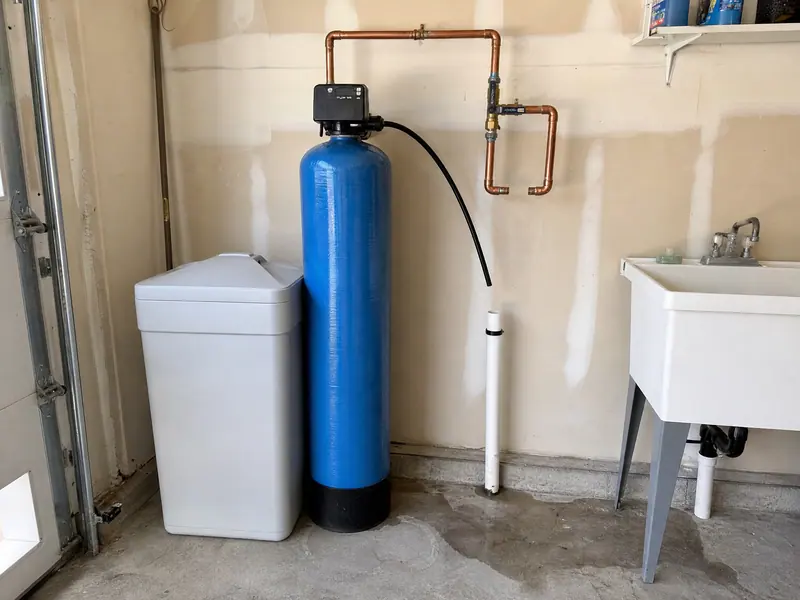
Does a water softener waste water?
It uses water, and how much depends on how often it regenerates. Penn State Extension's water softening guide (updated September 8, 2025) estimates about 50 gallons per regeneration, and University of Nebraska extension gives the same figure: about 2.5 standard 20-gallon washer loads, or 3.5 ENERGY STAR loads at 14 gallons (see replacing a washer). A softener is a choice about hardness, not a water-saving device, and this page does not judge whether you need one.
What can be judged is the control. Penn State says timer models "will waste more water and salt because they regenerate whether the resin needs it or not", while demand-control models usually regenerate after a set number of gallons have been softened.
Why do timer softeners use more water?
Because a calendar cannot see how much water you used. A timer, which California law calls clock control, regenerates on a preset schedule, so a week away still costs its cycles. A demand control unit starts from the state of the resin or the measured volume through it, so a quiet week means fewer cycles.
| Scenario | Regenerations a year | Gallons a year |
|---|---|---|
| Demand, Penn State example, every 7 days | 52 | 2,600 |
| Demand, Penn State example, every 6 days | 61 | 3,050 |
| Timer set every 4 days | 91 | 4,550 |
| Timer set every 3 days | 122 | 6,100 |
Source under the table: Penn State Extension, Water Softening. Our arithmetic: about 50 gallons per regeneration times regenerations a year; the demand rows use Penn State's sizing example, the timer rows are our own settings chosen to show the effect.
Penn State's example: a 20,000-grain unit, four people at 75 gallons a day each, 10 grains per gallon of hardness. That is 3,000 grains a day, so a recharge every six or seven days. For scale, the average household's leaks waste more than 9,300 gallons a year by EPA's count; a meter leak test finds those, as long as the softener is not mid-cycle while you watch.
How hard does water have to be before a softener makes sense?
That is your call, but measure first. The USGS hardness scale calls 0 to 60 mg/L (as calcium carbonate) soft, 61 to 120 moderately hard, 121 to 180 hard, and more than 180 very hard. Softener settings use grains per gallon instead, and at 17.1 mg/L to the grain the USGS breakpoints land near 3.5, 7.0 and 10.5 grains by our division.
USGS says heated hard water leaves scale that can shorten equipment life, raise water-heating costs and clog pipes. NDSU Extension adds that deposits plug fixtures; see bathroom faucet aerators. Neither puts a percentage on it, and we found no federal figure to rely on.
What does California require?
Under the state's water softener statute (archived copy; text effective January 1, 2000), a softener that regenerates on site and drains to the sewer may be installed only if it uses demand control. Units installed on or after January 1, 2002 must remove at least 4,000 grains of hardness per pound of salt, certified by a third party. The same section calls for flow restrictors on fixtures that get softened water and for unsoftened water at outdoor hose bibs. These are rules for new installations, not orders to remove existing units.
Local agencies may go further. In the Santa Clarita Valley, the Sanitation Districts of Los Angeles County barred new automatic softeners from March 27, 2003, and a 2008 ordinance ordered existing ones out by June 30, 2009, to cut chloride in the Santa Clara River. Check your own sewer agency before buying.
Does it matter if you are on a septic system?
It is one more reason to keep cycles down. Penn State gives its 50-gallon figure while discussing septic load, and every skipped regeneration is water the tank does not have to take. The kitchen and laundry overview sets this beside the room's other appliances.
When the answer flips
- Your water tests soft or only moderately hard: there may be no hardness problem to solve, and every regeneration is 50 gallons you would not otherwise use.
- Your timer model can be set to regenerate by volume: reprogramming it may bring it close to a demand unit's cycle count.
- Your sewer agency limits softeners, as in the Santa Clarita Valley: the choice may be made for you, including for units already installed.
What to buy or ask a plumber
- Ask for demand-initiated (metered) regeneration, and ask how the unit decides when to regenerate.
- Ask for the salt efficiency in grains of hardness removed per pound of salt, certified by a third party; California's floor is 4,000.
- Test your hardness and give the installer the number, so capacity matches your water and household.
- Cutting into the main line, and any brine drain or electrical work, is for a licensed plumber or electrician where your code requires it.
Also asked
How often should a water softener regenerate?
Divide the resin's capacity in grains by hardness times daily gallons. Penn State's family of four at 10 grains per gallon comes out at every six or seven days.
Can I reprogram an old timer softener to use less water?
Sometimes. NDSU Extension notes that many timer models can also be set to recharge by the volume of water used, so check the control's manual before replacing anything.
Do I have to remove my softener in California?
Not under state law, which governs new installations. A local agency can ban sewer-discharging units by ordinance after specific findings, as the Santa Clarita Valley did.
What does "grains per pound of salt" tell me?
How much hardness the unit removes per pound of regeneration salt. Higher is better; California's floor is 4,000.
How we reached this
The 50-gallon figure is an extension estimate from Penn State (updated September 8, 2025) and University of Nebraska (revised 2014); neither splits it by unit size or control type, so our ledger treats every cycle as 50 gallons. The demand rows rest on Penn State's sizing example; the timer settings are ours, picked to show the effect, not drawn from any survey. California rules come from an archived copy of the statute captured May 30, 2025, and Santa Clarita details from an archived Sanitation Districts page. Percentage savings claimed for demand units online came from no source we could confirm, so none appear here.
Sources
- Penn State Extension — Water Softening · about 50 gallons per regeneration, timer versus demand, sizing example · checked 11 Nov 2026
- University of Nebraska–Lincoln Extension — G1491 Drinking Water Treatment: Water Softening · about 50 gallons per regeneration · checked 11 Nov 2026
- NDSU Extension — Water Softening (Ion Exchange), WQ1031 · demand-initiated regeneration, timer models set by volume, scale plugging fixtures · checked 11 Nov 2026
- USGS Water Science School — Hardness of Water · hardness classes, effects of scale · checked 11 Nov 2026
- California Health and Safety Code §§116775–116795, Water Softeners · demand control rule, 4,000 grains per pound, 17.1 mg/L per grain · archived copy of 30 May 2025, checked 11 Nov 2026
- Sanitation Districts of Los Angeles County — Automatic Water Softeners in the Santa Clarita Valley · 2003 install ban, 2009 removal deadline, 8,000+ units removed · archived copy of 24 Feb 2026, checked 11 Nov 2026
- US EPA WaterSense — Fix a Leak Week · average household leaks of more than 9,300 gallons a year · checked 11 Nov 2026
More from the kitchen and laundry
 Dishwasher or hand washing: which uses less water?Run a full ENERGY STAR dishwasher rather than washing by hand; scrape plates and skip the pre-rinse.Use it8,400 gal
 Should you replace an old washing machine?Keep a working washer; when it fails, buy ENERGY STAR, which uses about 14 gallons a load instead of 20.Upgrade later1,800 gal
 What kitchen faucet flow rate should you choose?Keep a working 2.2 gpm faucet and shorten how long it runs; choose 1.8 gpm when you replace it.Habits first10 gal