Bathroom faucet · a decision
Should you swap your bathroom faucet aerator?
Faucet aerator gpm is the cheapest number to change in a bathroom: a WaterSense aerator caps the sink at 1.5 gallons a minute, and EPA says that saves the average family 700 gallons a year.
700 gal
gallons a year the average family saves with WaterSense labeled bathroom faucets or aerators (EPA)
Screw on a 1.5 gpm WaterSense aerator if the faucet is marked 2.2 gpm or unmarked; the faucet can usually stay.
Worked out by Where Your Gallons Go from 10 dated sources · numbers checked 11 November 2026
The answer by situation
- Aerator marked 2.2 gpm, or no markingSwap itA 1.5 gpm aerator flows 32% less; 4 minutes of full flow a day saves about 1,022 gallons a year.
- Aerator already 1.5 gpm or lowerKeepYou are at the WaterSense limit; clean it if the stream narrows.
- Stream sputters or sprays sidewaysClean firstScale can plug the screen; soak it before you replace anything.
- Faucet drips when offFix the faucetAn aerator does nothing for a drip, which can top 3,000 gallons a year.
- Kitchen sinkDifferent pageWaterSense labels no kitchen faucets; see the kitchen faucet decision.
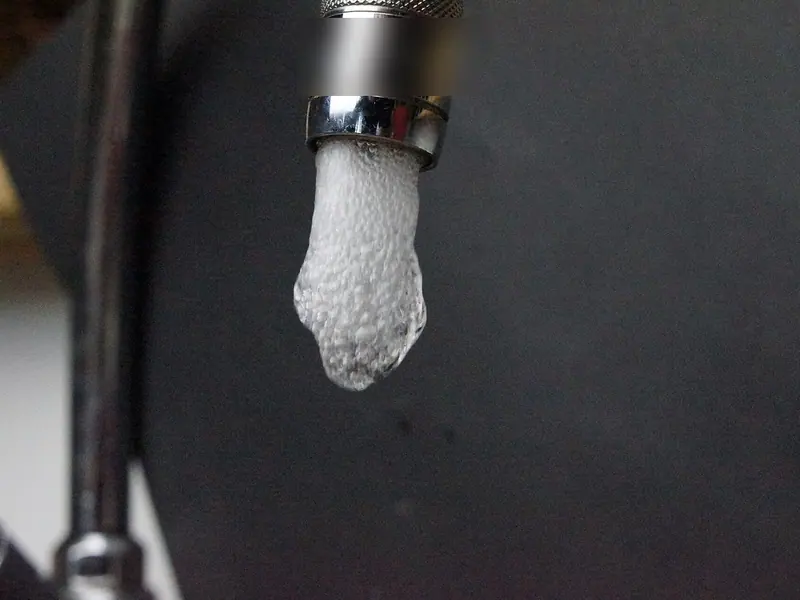
What does a faucet aerator do?
It mixes air into the stream and sets the faucet's top flow. The small screw-on piece at the spout is rated in gallons per minute, and changing it changes the faucet's flow without touching the valve or the supply lines. Federal rules cap bathroom faucets and replacement aerators made after January 1, 1994 at 2.2 gpm at 60 psi (10 CFR 430.32).
How much does a 1.5 gpm aerator save?
EPA's Bathroom Faucets page says WaterSense faucets and aerators save the average family 700 gallons a year and nearly 11,000 gallons over their life. EPA's Statistics and Facts page adds about $250 in water and water-heating costs over that life. Faucets are 19% of indoor water use in EPA's breakdown, close behind the shower.
| Faucet or aerator | Gallons a minute at 60 psi | Gallons a year, 4 minutes a day | Saved a year against 2.2 gpm |
|---|---|---|---|
| Federal maximum since 1994 | 2.2 | 3,212 | baseline |
| WaterSense labeled | 1.5 | 2,190 | 1,022 |
| California limit, made from July 1, 2016 | 1.2 | 1,752 | 1,460 |
| EPA's average family estimate | — | — | 700 |
Source under the table: eCFR 10 CFR 430.32; WaterSense faucet specification; CEC 2015 regulations. Our arithmetic for 4 minutes of full flow a day, an example we chose; most sink use runs below full flow, so EPA's 700-gallon family figure is the realistic one.
Will a 1.5 gpm aerator feel too weak?
It is built not to. The WaterSense faucet specification (effective October 1, 2007) sets a maximum of 1.5 gpm at 60 psi and a minimum of 0.8 gpm at 20 psi, so a labeled aerator still runs usefully when pressure is low. Hand washing and tooth brushing need little flow; filling a bucket just takes longer.
Why does the aerator keep clogging?
Usually scale or grit. Hard water leaves deposits that, in NDSU Extension's words, accumulate to plug plumbing fixtures. The USGS calls water above 120 mg/L hard and above 180 mg/L very hard; one grain per gallon is about 17.1 mg/L. A home hardness test tells you which you have, and water softener water use covers what treating it costs in water.
Do state rules require a lower flow?
Mostly for new products sold or made after a date. The exception is California's retrofit law: in homes built on or before January 1, 1994, faucets over 2.2 gpm had to be replaced by January 1, 2017 in single-family homes (2019 for multifamily), with a few exemptions. California limits bathroom faucets and aerators made on or after July 1, 2016 to 1.2 gpm at 60 psi (CEC 2015 regulations); Vermont sets 1.5 gpm for new faucets sold from July 1, 2021, and Colorado and Washington have their own sales rules. EPA drafted a 1.2 gpm WaterSense limit in December 2024 but paused the work in February 2025. The state fixture rules page lists each state.
When is the faucet, not the aerator, the problem?
When it drips with the handle off. EPA's Fix a Leak Week page puts a one-drip-per-second faucet above 3,000 lost gallons yearly, and no aerator touches that. See dripping faucet; replacing a whole faucet starts with closing both stop valves under the sink and opening the faucet to let the pressure off.
When the answer flips
- Your faucet is already marked 1.5 gpm or less: the saving is gone; keep it and clean the screen.
- You live in California and the faucet was made after mid-2016: it should already be 1.2 gpm.
- The house pressure is well below 45 psi: fix that first; EPA's working range for fixtures is 45 to 60 psi.
- The sink is rarely used: few minutes of flow means few gallons saved.
What to buy or ask a plumber
- Look for the WaterSense label and 1.5 gpm (or lower) printed on the aerator.
- Note whether your spout threads are inside or outside before buying.
- Ask a plumber to replace the faucet if it drips and the stop valves under the sink will not close.
- Test hardness if aerators clog within months.
Also asked
Can I tell an aerator's flow rate without a marking?
Time it: run the tap fully into a container for 15 seconds, measure the gallons and multiply by four. A result above 1.5 means a WaterSense aerator would cut the flow.
Does turning off the tap while brushing matter as much as the aerator?
It can matter more. EPA says turning the tap off while brushing saves 8 gallons a day, against roughly 2 a day (700 a year) for a family's aerators, our arithmetic.
Do aerators save hot water too?
Yes, whenever the hot side is open. EPA's lifetime figure of about $250 counts both water and the energy used to heat it.
Why is there no WaterSense kitchen faucet?
WaterSense labels bathroom faucets and aerators only. The kitchen faucet flow page covers kitchen limits and what to look for instead.
The bathroom page compares this with the showerhead swap and the toilet decisions.
How we reached this
This verdict uses EPA's 700-gallon family estimate and the WaterSense specification as its base, with the federal 2.2 gpm limit from the eCFR text as of November 2026. The 4-minute daily example in the ledger is ours, picked to show scale, and it overstates real use because most sink time is at partial flow. Scale and hardness facts come from USGS and NDSU Extension; no source we found puts a number on how fast scale clogs an aerator.
Sources
- US EPA WaterSense — Bathroom Faucets · 700 gallons a year, 11,000 over the life, 1.2 gpm draft paused February 2025 · checked 11 Nov 2026
- US EPA — High-Efficiency Lavatory Faucet Specification · 1.5 gpm at 60 psi, 0.8 gpm at 20 psi, 32% below 2.2 · checked 11 Nov 2026
- US EPA WaterSense — Statistics and Facts · $250 lifetime, 8 gallons a day while brushing · checked 11 Nov 2026
- US EPA WaterSense — How We Use Water · faucets 19% of indoor use (WRF 2016) · checked 11 Nov 2026
- eCFR — 10 CFR 430.32, faucets · 2.2 gpm at 60 psi for faucets and aerators made after Jan 1, 1994 · checked 11 Nov 2026
- California Energy Commission — 2015 fixture regulations · 1.2 gpm lavatory limit from July 1, 2016 · checked 11 Nov 2026
- Vermont 9 V.S.A. §2796 · 1.5 gpm for new faucets sold from July 1, 2021 · checked 11 Nov 2026
- USGS Water Science School — Hardness of Water · hardness classes · checked 11 Nov 2026
- NDSU Extension — Water Softening (Ion Exchange) · scale plugs plumbing fixtures · checked 11 Nov 2026
- US EPA WaterSense — Fix a Leak Week · drip once a second, more than 3,000 gallons a year · checked 11 Nov 2026
More from the bathroom
 Should you replace an old toilet?Replace it if it was made before 1994; keep a working 1.6 gpf toilet unless it leaks or you remodel.Replace10,640 gal
 Running toilet: fix it or replace it?Fix a running toilet this week; replace the whole toilet only if it is a pre-1994 model or the china is cracked.Fix now200 gal a day
 Dual flush or single flush: which saves more?Either works; pick dual flush only if its full flush is 1.28 gpf or less and your household uses the half button.Depends1,530 gal
 Is a low-flow showerhead swap worth it?Swap a head that fills a gallon in under 20 seconds for a WaterSense model rated 2.0 gpm or less.Swap it2,700 gal
 Bath or shower: which uses less water?Shower for everyday washing; a full bath uses about as much as a 35-minute shower on a 2.0 gpm head.Shower54 gal