Kitchen faucet · a decision
What kitchen faucet flow rate should you choose?
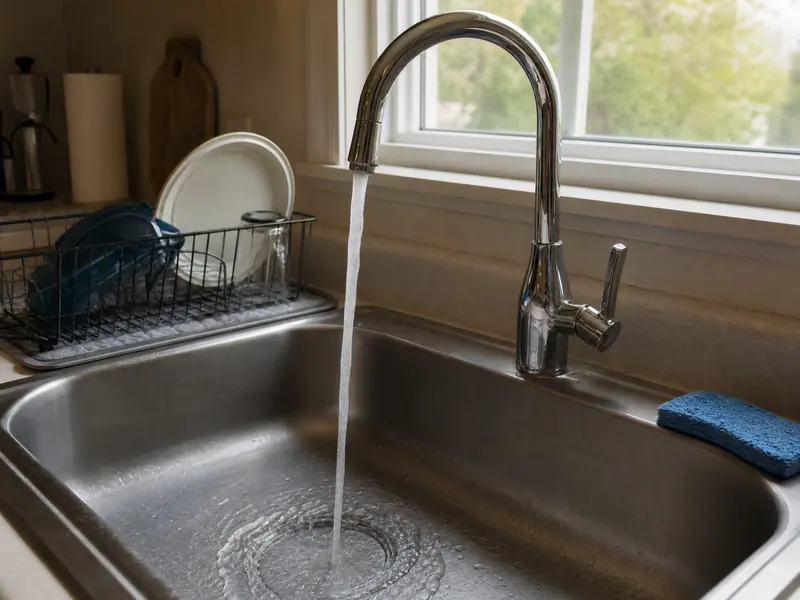
Kitchen faucet flow rate matters less than how long the tap runs: the federal cap is 2.2 gallons a minute, and five open minutes at the sink use about 10 gallons.
10 gal
gallons from leaving the kitchen tap running five minutes while washing dishes (EPA Statistics and Facts)
Keep a working 2.2 gpm faucet and shorten how long it runs; choose 1.8 gpm when you replace it.
Worked out by Where Your Gallons Go from 8 dated sources · numbers checked 11 November 2026
The answer by situation
- Working faucet, any ratingKeep itIn our example, shutting the tap two minutes sooner each day saves about 1,600 gallons a year, more than a 1.8 gpm swap.
- Replacing the faucet anywayPick 1.8 gpmAlready the sales limit for new kitchen faucets in California, Colorado, Washington and Vermont.
- Faucet may predate 1994Time itThe 2.2 gpm federal cap covers only faucets made after January 1, 1994; a one-gallon jug tells you the real flow.
- Sink used mostly to fill potsFlow barely mattersA two-gallon pot takes two gallons at any rating; only the wait changes.
What is the legal flow rate for a kitchen faucet?
Nationally, 2.2 gallons a minute at 60 psi. Under 10 CFR 430.32(o), kitchen faucets and kitchen replacement aerators made after January 1, 1994 may not pass more than that. The rule covers new products; a faucet already on your sink is not affected.
Some states go lower for faucets sold there. California's 2015 appliance rules, in the Energy Commission's adopted text, set 1.8 gpm for kitchen faucets sold on or after January 1, 2016, with an optional temporary 2.2 gpm setting. Colorado applied the same 1.8 limit to kitchen faucets sold new there starting January 1, 2021, Washington adopted California's table for products made on or after that date, and Vermont's statute has done so for sales since July 1, 2021. Georgia asks for 2.0 gpm or less in building work permitted from mid-2012 onward, and its definition of construction includes swapping a worn-out faucet. The state fixture rules page lists the rest.
Is there a WaterSense label for kitchen faucets?
No. EPA's WaterSense faucet specification covers private bathroom and bar sink faucets only, at 1.5 gpm or less. A kitchen faucet sold as "low flow" has no federal label behind the claim, so read the rated gpm printed on the box or spec sheet instead. The bathroom version is covered on the bathroom faucet aerator page.
How much water does a lower flow rate really save?
Less than the label suggests, because much kitchen water is measured by the pot, not the minute. The savings come only from tasks where the tap simply runs: rinsing, scrubbing, waiting for hot water. EPA's Statistics and Facts page counts about 10 gallons when a tap runs five minutes during dishwashing.
| Scenario | Gallons a day | Gallons a year | Water and sewer a year |
|---|---|---|---|
| 2.2 gpm, tap open 5 minutes | 11 | 4,015 | $24.33 |
| 1.8 gpm, tap open 5 minutes | 9 | 3,285 | $19.91 |
| Saving from the 1.8 gpm faucet | 2 | 730 | $4.42 |
| Saving from 2.2 gpm, tap shut 2 minutes sooner | 4.4 | 1,606 | $9.73 |
Source under the table: EPA Statistics and Facts, with federal and California limits. Our arithmetic: flow rate times five minutes a day times 365 days, with water priced at EPA's calculator assumption of $6.06 per 1,000 gallons; five minutes is our example, not a measured average.
The last row is the point: two fewer minutes of open tap on the old faucet saves more than twice what the new one would, which is also why the dishwasher or hand washing verdict favors the machine.
How can you measure your faucet's real flow?
Time a one-gallon jug. Open the faucet fully, start a timer, and stop it when the jug fills. Divide 60 by the seconds: 27 seconds is about 2.2 gpm, 33 seconds about 1.8. The rating is set at 60 psi, so a home with much higher pressure may see more; the pressure reducing valve page explains how to check yours with a gauge.
What should you check before swapping a kitchen faucet?
The two stop valves under the sink. Close both, then open the faucet to let the pressure off before loosening anything. If a valve will not turn or keeps dripping when closed, replace it first; the dripping faucet page covers that job and when it is a plumber's.
When the answer flips
- Your faucet was made before 1994 and fills a gallon in well under 27 seconds: a new 1.8 gpm faucet saves more than the 730 gallons in our example.
- You leave the tap running far longer than five minutes a day: savings from both a lower rating and shorter habits grow in proportion.
- You live in Georgia and are replacing a faucet: the state's new-construction rule, which counts replacements, asks for 2.0 gpm or less.
- Your sink use is mostly filling pots and kettles: a lower flow rate saves almost nothing and only slows the fill.
What to buy or ask a plumber
- Read the rated flow on the box or spec sheet: 1.8 gpm is the sales limit in four states; 2.2 gpm is the federal maximum.
- For a temporary 2.2 gpm setting, ask how it returns to the lower flow.
- Check that the faucet fits the number of holes in your sink, so no new holes need drilling.
- Have a plumber replace any stop valve that will not shut, or any supply connection you are unsure about.
Also asked
What does "optional temporary 2.2 gpm" mean on a California faucet?
California's rule lets a kitchen faucet rated at 1.8 gpm offer a temporary 2.2 gpm flow, for jobs such as filling a pot. The normal flow stays at 1.8.
Will a 1.8 gpm faucet take longer to fill a pot?
Yes, a little. A two-gallon pot fills in about 55 seconds at 2.2 gpm and about 67 seconds at 1.8, by simple division.
Do the state limits mean I must replace my kitchen faucet?
Usually not. California, Colorado, Washington and Vermont limit what may be sold, and Georgia's rule applies when a faucet is installed under a permit. The exception is a California home built on or before January 1, 1994: an interior faucet over 2.2 gpm was due for replacement by January 1, 2017 in a single-family home (2019 for multifamily), with a few exemptions.
Is a kitchen faucet a big share of household water?
All faucets together are about 19% of indoor use in a single-family home, by the 2016 Water Research Foundation study charted on EPA's How We Use Water page. That figure covers bathroom and kitchen taps combined.
How we reached this
This verdict leans on arithmetic rather than measured kitchen use, because we found no published figure for how long an average kitchen tap runs. The five-minute day is an example built on EPA's dishwashing figure; change it to your own habits and the ratios stay the same. Legal limits come from the federal rule in its 9 Nov 2026 eCFR version, the California Energy Commission's 2015 adopted text (later renumbering not checked), Vermont's statute, Colorado's session laws in archived copies, and Georgia's Water Stewardship Act. Dollar figures use EPA's assumed rate and ignore water-heating energy.
Sources
- eCFR — 10 CFR 430.32 Energy and water conservation standards · 2.2 gpm at 60 psi for kitchen faucets made after Jan 1, 1994 · checked 11 Nov 2026
- California Energy Commission — Toilet, Urinal, Faucet and Showerhead Regulations 2015 (TN 206010) · 1.8 gpm with optional temporary 2.2 for kitchen faucets sold from Jan 1, 2016 · checked 11 Nov 2026
- Colorado HB19-1231 signed act · 1.8 gpm for new kitchen faucets sold from Jan 1, 2021 · archived copy of 11 Mar 2025, checked 11 Nov 2026
- Washington State Legislature — RCW 19.260 · adoption of California's table for products made from Jan 1, 2021 · checked 11 Nov 2026
- Vermont General Assembly — 9 V.S.A. §2796 · 1.8 gpm kitchen limit for sales from July 1, 2021 · checked 11 Nov 2026
- Georgia EPD — Georgia Water Stewardship Act · 2.0 gpm kitchen faucets in new construction from July 1, 2012 · checked 11 Nov 2026
- US EPA — High-Efficiency Lavatory Faucet Specification · WaterSense covers bathroom faucets only · checked 11 Nov 2026
- US EPA WaterSense — Statistics and Facts · 10 gallons for five minutes of running tap · checked 11 Nov 2026
More from the kitchen and laundry
 Dishwasher or hand washing: which uses less water?Run a full ENERGY STAR dishwasher rather than washing by hand; scrape plates and skip the pre-rinse.Use it8,400 gal
 Should you replace an old washing machine?Keep a working washer; when it fails, buy ENERGY STAR, which uses about 14 gallons a load instead of 20.Upgrade later1,800 gal
 Does a water softener waste water?A softener is a hardness choice, not a water saver; if you have or need one, choose demand regeneration.Demand control~50 gal