Toilet · a decision
Should you replace an old toilet?
Replace an old toilet if it was made before 1994: at 3.5 gallons a flush it uses close to three times what a 1.28 gpf WaterSense model needs for the same flushes.
10,640 gal
gallons a year saved replacing a 3.5 gpf toilet with 1.28 gpf, 2.6-person home (our arithmetic, EPA assumptions)
Replace it if it was made before 1994; keep a working 1.6 gpf toilet unless it leaks or you remodel.
Worked out by Where Your Gallons Go from 11 dated sources · numbers checked 11 November 2026
The answer by situation
- Toilet installed before 1980 (about 5 gpf)ReplaceSaves about 17,830 gallons yearly for an average household, our arithmetic.
- Toilet from 1980 to 1994 (about 3.5 gpf)ReplaceSaves about 10,640 gallons a year, close to $64 at EPA's assumed rate.
- Working 1.6 gpf toilet from after 1994KeepGoing to 1.28 gpf saves only about 1,530 gallons, roughly $9 a year.
- 1.6 gpf toilet that runs or rocksFix firstA worn flapper is a small part; a fill valve stuck open loses 4,300 gallons daily.
- Bathroom remodel with the floor openReplaceA 1.28 gpf model uses 20% less per flush than the 1.6 gpf federal maximum.
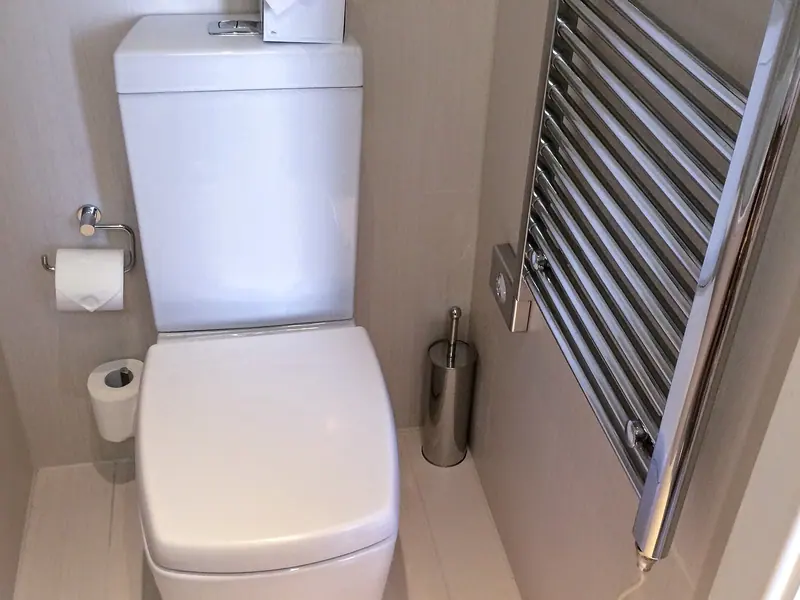
How do you know how old your toilet is?
Age is the usual clue to flush volume. Federal rules cap toilets made after January 1, 1994 at 1.6 gallons per flush (10 CFR 430.32), so a toilet installed before then is likely to use more. Look for a gpf or Lpf marking on the bowl or tank; if there is none, EPA's WaterSense calculator treats it as 3.5 gpf.
How many gallons does a new toilet save each year?
In a 2.6-person home, a 3.5 gpf toilet swapped for a 1.28 gpf model saves about 10,640 gallons a year. That is our arithmetic from the calculator's assumptions. EPA's Residential Toilets page (updated May 29, 2026) says swapping every old toilet in a home saves nearly 13,000 gallons, or upward of $170, yearly.
| Toilet you have now | Gallons a year now | Gallons a year at 1.28 gpf | Gallons saved a year | Water dollars saved a year |
|---|---|---|---|---|
| About 5 gpf (installed before 1980) | 23,961 | 6,134 | 17,827 | $108 |
| About 3.5 gpf (1980 to 1994) | 16,773 | 6,134 | 10,639 | $64 |
| 1.6 gpf (after 1994) | 7,668 | 6,134 | 1,534 | $9 |
Source under the table: EPA WaterSense calculator assumptions. Our arithmetic from EPA's calculator inputs (2.6 people, 4,792 flushes a year, $6.06 per 1,000 gallons); your rate will differ.
The dollars use EPA's assumed rate; multiply the gallons saved by your bill's price per 1,000 gallons and compare with your quote.
Is a 1.6 gpf toilet worth replacing?
Usually not, if it flushes well and does not leak: the step to 1.28 gpf saves about 1,530 gallons a year, around $9 at EPA's rate. Replace it when it cracks or a remodel removes it. A leak matters more than the flush: a fill valve that sticks open may send 4,300 gallons a day down the drain, per EPA's Know Your Flow guide (see running toilet: fix or replace).
Do 1.28 gpf toilets flush well enough?
Yes, by test. EPA's performance overview says labeled tank toilets must clear 350 grams of soybean-paste test media and four balls of toilet paper in four of five flushes, and any toilet now sold in the US or Canada, labeled or not, must meet that bar. For more margin, check the model's MaP score, which tests loads up to 1,000 grams.
What do the rules require for toilets you already have?
Outside California, usually nothing: federal and state caps bind new toilets at the factory or the store. California and Texas limit toilets sold since January 1, 2014 to 1.28 gpf, and Georgia applies 1.28 gpf when a worn-out toilet is replaced. California also required single-family homes built on or before January 1, 1994 to replace toilets over 1.6 gpf by January 1, 2017 (2019 for multifamily; a few exemptions apply) (Civil Code article 1.4, archived copy of 22 Sep 2025), and some cities add rules at sale or remodel, so check locally. The state fixture rules page lists the others.
Who should do the swap?
Many homeowners do it; the toilet is heavy and the seal must be right. A cracked flange or a soft floor around it is a plumber's call.
When the answer flips
- You have a 1.6 gpf toilet that works: the saving drops to about 1,530 gallons a year, so keep it until it fails.
- One person lives alone: a 3.5 gpf swap then saves about 4,090 gallons a year (our arithmetic).
- Your utility pays a rebate: Denver Water offers up to $100 for a toilet averaging 0.8 gpf or less (checked 11 Nov 2026).
What to buy or ask a plumber
- Look for the WaterSense label (1.28 gpf or less) and check the model's MaP flush score.
- Measure the rough-in: the distance from the wall to the center of the floor bolts.
- Ask whether the quote includes a new wax ring and supply line.
- If your utility pays a rebate, ask which models qualify before you buy; some set 1.1 or 0.8 gpf.
Also asked
Does EPA's $170 a year apply to my home?
It is EPA's figure for replacing every old toilet in an average home. Our ledger shows one toilet; your rate sets the dollars.
Is a toilet with a 6 gallon tank still legal to use?
In most states, yes: the limits cover toilets made or sold after their dates. In a California single-family home built on or before January 1, 1994, it was due for replacement by January 1, 2017 (2019 for multifamily), unless an exemption applies, and a seller must disclose it.
Will a lower-flow toilet clog my old drain line?
Every toilet sold now must pass EPA's flush test. Old drain lines with roots or sags clog with any toilet; if yours backs up often, have a plumber check the line first.
Does any utility pay for 1.1 gpf toilets?
The Seattle-area utilities behind savingwater.org pay up to $100 a toilet, two per home, for MaP PREMIUM models at 1.1 gpf or less (checked 11 Nov 2026). Rebates change; check your own utility.
The bathroom page ranks this against the room's other decisions; replace now or when it breaks covers timing.
How we reached this
This verdict rests on EPA's calculator method, checked 11 Nov 2026: its flush volumes by installation date, 5.05 flushes a day, a 2.6-person home and $6.06 per 1,000 gallons. We multiplied those out and rounded headline figures to ten gallons. Fixture cost, labor and rebates are left out. California's retrofit rule is from an archived Civil Code copy of 22 Sep 2025. Worn parts can push real flushes above the label; we found no national figure for how far.
Sources
- US EPA WaterSense — How the WaterSense Calculator Works · all calculator assumptions · checked 11 Nov 2026
- US EPA WaterSense — Residential Toilets · 1.28 gpf label limit, nearly 13,000 gallons and $170 a year (updated May 29, 2026) · checked 11 Nov 2026
- eCFR — 10 CFR 430.32, water closets · 1.6 gpf for toilets made after Jan 1, 1994 · checked 11 Nov 2026
- US EPA — WaterSense Performance Overview: Tank-Type Toilets · 350 g flush test, MaP up to 1,000 g · checked 11 Nov 2026
- US EPA — Know Your Flow, February 2026 · stuck fill valve 4,300 gallons a day · checked 11 Nov 2026
- California Energy Commission — 2015 fixture regulations · 1.28 gpf sales rule · checked 11 Nov 2026
- Texas Health and Safety Code ch. 372 · 1.28 gpf sales rule from Jan 1, 2014 · checked 11 Nov 2026
- California Legislative Information — Civil Code article 1.4 · toilet retrofit by 2017 · archived copy of 22 Sep 2025, checked 11 Nov 2026
- Georgia EPD — Georgia Water Stewardship Act · new construction from July 1, 2012, including replacements · checked 11 Nov 2026
- Denver Water — toilet rebates · up to $100 for 0.8 gpf or less · checked 11 Nov 2026
- savingwater.org (Seattle-area utilities) — toilet replacement rebate · up to $100 a toilet, two per home, 1.1 gpf MaP PREMIUM · checked 11 Nov 2026
More from the bathroom
 Running toilet: fix it or replace it?Fix a running toilet this week; replace the whole toilet only if it is a pre-1994 model or the china is cracked.Fix now200 gal a day
 Dual flush or single flush: which saves more?Either works; pick dual flush only if its full flush is 1.28 gpf or less and your household uses the half button.Depends1,530 gal
 Is a low-flow showerhead swap worth it?Swap a head that fills a gallon in under 20 seconds for a WaterSense model rated 2.0 gpm or less.Swap it2,700 gal
 Should you swap your bathroom faucet aerator?Screw on a 1.5 gpm WaterSense aerator if the faucet is marked 2.2 gpm or unmarked; the faucet can usually stay.Swap it700 gal
 Bath or shower: which uses less water?Shower for everyday washing; a full bath uses about as much as a 35-minute shower on a 2.0 gpm head.Shower54 gal