Showerhead · a decision
Is a low-flow showerhead swap worth it?
A low flow showerhead is one of the cheapest water swaps in the house: EPA says WaterSense labeled heads save the average family 2,700 gallons and more than 330 kWh a year.
2,700 gal
gallons a year the average family saves with WaterSense labeled showerheads (EPA)
Swap a head that fills a gallon in under 20 seconds for a WaterSense model rated 2.0 gpm or less.
Worked out by Where Your Gallons Go from 10 dated sources · numbers checked 11 November 2026
The answer by situation
- Head fills a 1-gallon bucket in under 20 secondsSwap itThat is faster than 3 gpm; a 2.0 gpm head saves about 1,460 gallons a year per daily 8-minute shower against 2.5.
- Head made before 1994 or unmarkedSwap itOlder heads ran as high as 5.5 gpm, the Department of Energy's archived page says.
- Head marked 2.5 gpm that you likeDependsGoing to 2.0 saves about 1,460 gallons a year per daily shower; going to 1.8 saves about 2,040.
- Head already WaterSense labeledKeepIt is at 2.0 gpm or less; fix drips instead, since 10 drips a minute wastes 500+ gallons a year.
- Weak spray at every fixtureTest firstCheck house pressure before blaming the head.
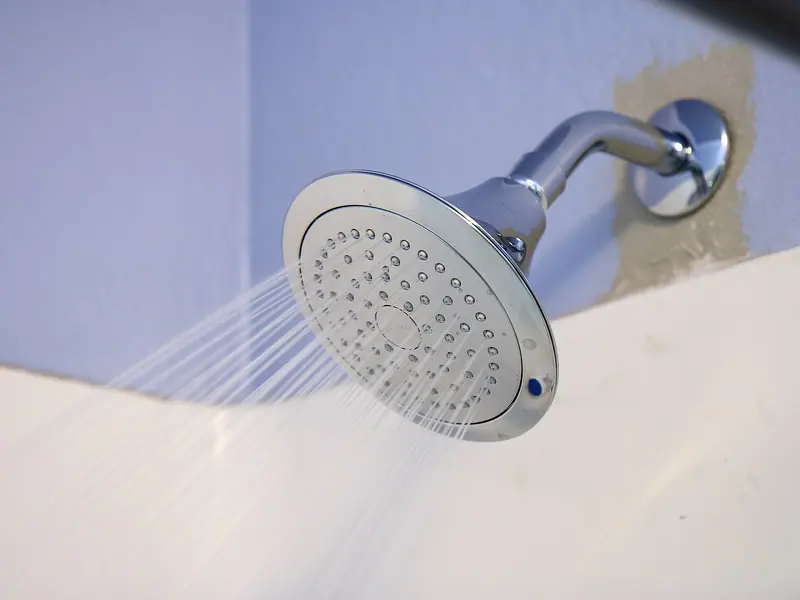
How do you tell if your showerhead uses too much water?
Time it with a bucket. The Department of Energy's archived hot water page says that if a 1-gallon mark fills in under 20 seconds, you could benefit from a low-flow head. Twenty seconds a gallon is 3 gallons a minute, our arithmetic, which is above the 2.5 gpm federal maximum for heads made after January 1, 1994 (10 CFR 430.32).
How much water does a lower-flow head save?
About 2,700 gallons a year for the average family, EPA's Showerheads page says, plus more than 330 kWh of water-heating energy. EPA's Statistics and Facts page (updated March 11, 2026) puts the combined water and electricity saving at about $70 a year. Showers use nearly 40 gallons a day in the average family home.
| Showerhead | Gallons per 8-minute shower | Gallons a year | Saved a year against 2.5 gpm |
|---|---|---|---|
| Older head at 5.5 gpm (DOE) | 44 | 16,060 | uses 8,760 more |
| Federal maximum, 2.5 gpm | 20 | 7,300 | baseline |
| WaterSense, 2.0 gpm | 16 | 5,840 | 1,460 |
| California limit, 1.8 gpm | 14.4 | 5,256 | 2,044 |
Source under the table: DOE archived hot water page; eCFR 10 CFR 430.32; WaterSense showerhead spec. Our arithmetic: rated flow times 8 minutes, times 365 days for one person; real flow runs below the rating at lower pressure.
Multiply the last column by the number of people who shower daily. Hot water is the bigger part of the dollar saving, so electric or gas rates matter as much as your water bill.
Will a 2.0 gpm showerhead feel weak?
It has to pass a spray test to carry the label. The WaterSense specification, version 1.1 (in effect since July 26, 2018), requires a spray force of at least 2.0 ounces at 20 psi and a coverage test, and checks flow at 20, 45 and 80 psi. If every tap in the house runs weak, the cause is likely pressure; see pressure-reducing valve for the gauge test.
What do the rules say about showerheads?
Mostly they cover new heads. The federal limit is 2.5 gpm at 80 psi for heads made after January 1, 1994, and it still stands after the definition rule changes: since May 15, 2025, the statutory definition of showerhead controls. California caps heads manufactured from July 1, 2018 at 1.8 gpm and required single-family homes built on or before January 1, 1994 to replace any head over 2.5 gpm by January 1, 2017 (2019 for multifamily), with a few exemptions; Colorado, Washington and Vermont have their own sales rules; state fixture rules has the details.
Why does the shower take so long to get hot?
That is the pipe, not the head. A small California pilot by Lawrence Berkeley National Laboratory (three homes, 2011) found about 30% of a typical shower's water went unused, much of it during the wait. The hot water pages cover recirculation and pipe insulation.
When the answer flips
- A shower valve leaks or will not shut off: that is valve work inside the wall, a job for a licensed plumber, not a head swap.
- Your home runs under 45 psi: EPA says fixtures work best at 45 to 60 psi, so a low-flow head may feel weak until the pressure problem is found.
- The household takes baths more than showers: the saving shrinks; see bath or shower.
- You live in California: a new head made since July 1, 2018 for sale there is 1.8 gpm or less already.
What to buy or ask a plumber
- Look for the WaterSense label and a rated flow of 2.0 gpm or less.
- Check the flow rating printed on the head or package: it is the maximum at 80 psi.
- Ask a plumber to look at the valve if the shower drips after you turn it off.
- If several family members shower daily, ask your utility whether it hands out labeled heads.
Also asked
Does a shower panel with several heads count as one showerhead?
The federal definition has changed three times since 2020, and since May 15, 2025 the definition in the statute controls. California counts the total flow of all nozzles running together toward its 1.8 gpm limit.
How much energy does a WaterSense showerhead save?
EPA puts it at more than 330 kWh a year for the average family, because most shower water is heated. The exact figure depends on your water heater.
Is a 1.8 gpm head worth it over 2.0 gpm?
For one daily 8-minute shower, the step from 2.0 to 1.8 saves about 584 gallons a year, our arithmetic. It is a smaller gain than leaving 2.5 behind.
How much does a dripping showerhead waste?
At 10 drips a minute, more than 500 gallons a year, EPA's Fix a Leak Week page says. See dripping faucet for the repair decision.
The bathroom page puts this swap next to the toilet and faucet decisions.
How we reached this
Our verdict leans on EPA's 2,700-gallon family figure and the WaterSense spray tests, with the Department of Energy's bucket test taken from a January 2026 archived copy because the live page has moved. Everything in the ledger is flow rate multiplied by an 8-minute shower we chose as an example; we did not use a study's average shower length. Energy savings vary with the heater, and we left out fixture prices. All rules were checked 11 Nov 2026.
Sources
- US EPA WaterSense — Showerheads · 2,700 gallons and 330 kWh a year, nearly 40 gallons a day · checked 11 Nov 2026
- US EPA — WaterSense Specification for Showerheads, Version 1.1 · 2.0 gpm, spray force and coverage tests · checked 11 Nov 2026
- US EPA WaterSense — Statistics and Facts · about $70 a year in water and electricity · checked 11 Nov 2026
- US DOE Energy Saver — Reduce Hot Water Use, archived copy of January 1, 2026 · bucket test, older heads to 5.5 gpm · checked 11 Nov 2026
- US DOE Energy Saver — Lower Water Heating Temperature, archived copy of January 1, 2026 · 120°F, scald risk at 140°F · checked 11 Nov 2026
- eCFR — 10 CFR 430.32, showerheads · 2.5 gpm at 80 psi, made after Jan 1, 1994 · checked 11 Nov 2026
- Federal Register — Repeal of the Definition of Showerhead, April 15, 2025 · statutory definition controls from May 15, 2025 · checked 11 Nov 2026
- California Energy Commission — 2015 fixture regulations · 1.8 gpm for heads made from July 1, 2018, multi-nozzle total · checked 11 Nov 2026
- Lawrence Berkeley National Laboratory — Water and Energy Wasted During Residential Shower Events (2011) · 30% of a typical shower's water wasted, three-home pilot · checked 11 Nov 2026
- US EPA WaterSense — Fix a Leak Week · 10 drips a minute, more than 500 gallons a year · checked 11 Nov 2026
More from the bathroom
 Should you replace an old toilet?Replace it if it was made before 1994; keep a working 1.6 gpf toilet unless it leaks or you remodel.Replace10,640 gal
 Running toilet: fix it or replace it?Fix a running toilet this week; replace the whole toilet only if it is a pre-1994 model or the china is cracked.Fix now200 gal a day
 Dual flush or single flush: which saves more?Either works; pick dual flush only if its full flush is 1.28 gpf or less and your household uses the half button.Depends1,530 gal
 Should you swap your bathroom faucet aerator?Screw on a 1.5 gpm WaterSense aerator if the faucet is marked 2.2 gpm or unmarked; the faucet can usually stay.Swap it700 gal
 Bath or shower: which uses less water?Shower for everyday washing; a full bath uses about as much as a 35-minute shower on a 2.0 gpm head.Shower54 gal