Toilet · a decision
Dual flush or single flush: which saves more?
Dual flush toilet pros and cons come down to one habit: the labeled average assumes two small flushes for every full one, so the saving depends on who pushes which button.
1,530 gal
gallons a year a 1.28/0.8 dual flush saves over a 1.28 single flush, 2 small to 1 full (our arithmetic)
Either works; pick dual flush only if its full flush is 1.28 gpf or less and your household uses the half button.
Worked out by Where Your Gallons Go from 8 dated sources · numbers checked 11 November 2026
The answer by situation
- Dual flush with a 1.28 gpf full flushChoose itUsed two small to one full, a 1.28/0.8 model saves about 1,530 gallons a year over a 1.28 single flush.
- Dual flush with a 1.6 gpf full flushSkip itIt averages about 1.27 gpf only at the 2:1 ratio; at one to one it uses 336 extra gallons yearly versus a 1.28 single.
- Household that never uses the small buttonSingle flushEvery flush is then a full one, up to 1.6 gpf on some dual models.
- Utility rebate set at 0.8 or 1.1 gpfCheck the listSome rebates set a lower average than the 1.28 label.
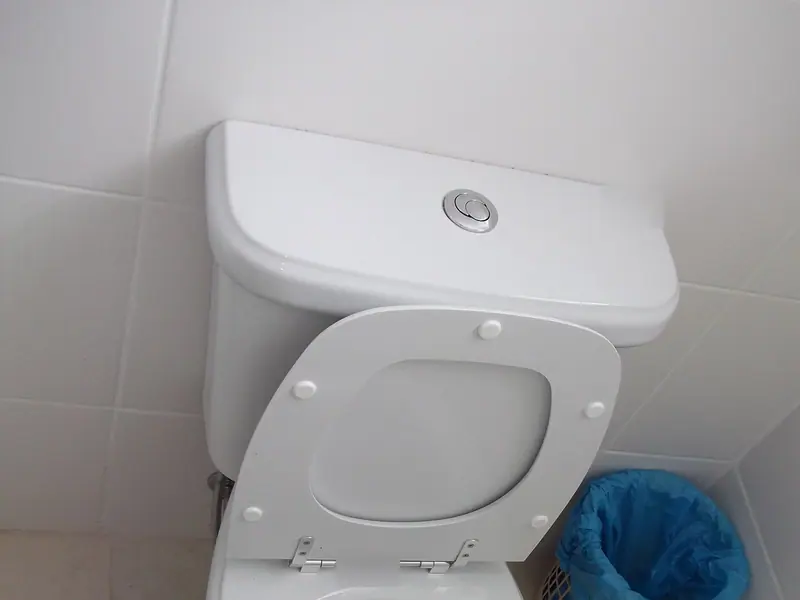
How is a dual-flush toilet's flush volume measured?
By an average that assumes two reduced flushes for every full one. The WaterSense tank-toilet specification, version 1.2, defines the effective flush volume of a dual-flush toilet as the average of two reduced flushes and one full flush, and that average must be 1.28 gallons or less. Texas law for toilets sold from January 1, 2014 and the Georgia Water Stewardship Act use the same two-plus-one rule.
Does a dual-flush toilet save more water than a 1.28 gpf single flush?
Only if its full flush is low and the half button gets used. A model with a 1.6 gallon full flush and a 1.1 gallon half flush works out to about 1.27 gpf on the label's math, which is nearly the same as a 1.28 single flush. A 1.28/0.8 model works out to about 0.96 gpf, which is a real gain. The table shows what happens to each when the household's habits drift from the 2:1 assumption.
| Toilet and habit | Average gallons per flush | Gallons a year | Compared with a 1.28 single flush |
|---|---|---|---|
| Single flush, 1.28 gpf | 1.28 | 6,134 | baseline |
| Dual 1.6/1.1, two small to one full | 1.27 | 6,070 | 64 fewer |
| Dual 1.6/1.1, one small to one full | 1.35 | 6,470 | 336 more |
| Dual 1.6/1.1, full flush every time | 1.60 | 7,668 | 1,534 more |
| Dual 1.28/0.8, two small to one full | 0.96 | 4,601 | about 1,530 fewer |
| Single flush, 1.1 gpf | 1.10 | 5,271 | 863 fewer |
Source under the table: EPA WaterSense calculator assumptions and tank-toilet spec v1.2. Our arithmetic: 4,792 flushes a year, the EPA calculator's figure for 2.6 people at 5.05 flushes each per day; the 1.6/1.1 and 1.28/0.8 models are worked examples, not named products.
What changes if EPA's paused version 2.0 takes effect?
The full flush would have to be 1.28 gpf or less on both kinds of toilet. EPA's Residential Toilets page says version 2.0 drops the effective-flush average, but EPA has paused its effective date and version 1.2 remains in effect until further notice. Until that changes, a 1.6/1.1 dual flush can still carry the label.
Is a dual-flush toilet worth it if you already have a 1.28 gpf toilet?
Rarely, for water alone. Even the 1.28/0.8 example saves about 1,530 gallons a year in an average home, around $9 at the $6.06 per thousand gallons EPA assumes. That is the same small margin as moving from a 1.6 to a 1.28 toilet, covered with the full payback ledger on replace an old toilet.
Which matters more than the flush type?
A leak, by a long way. One fill valve jammed open can pass 4,300 gallons in a single day, according to EPA's 2026 leak-flow sheet, which beats a full year of button savings. Dual-flush toilets have their own seals and valves; if either kind runs, see running toilet: fix or replace.
Does a rebate care which type you buy?
Some rebates care about the average, not the button. Denver Water pays up to $100 for a WaterSense toilet averaging 0.8 gpf or less, which a 1.6/1.1 dual flush would not meet (checked 11 Nov 2026). Check your own utility's list before buying; the water utility rebates page has more examples.
When the answer flips
- The full flush is 1.6 gallons: the label average holds only at two small flushes per full one, so a 1.28 single flush is the safer pick.
- Children or guests ignore the half button: usage drifts toward one to one, and the 1.6/1.1 model uses 336 more gallons a year.
- Your utility's rebate requires 0.8 or 1.1 gpf: buy from its list, whichever flush type qualifies.
- EPA puts version 2.0 into effect: dual-flush models with a full flush above 1.28 gpf could no longer be labeled.
What to buy or ask a plumber
- Read both numbers on the box: the full flush and the reduced flush, not only the average.
- Look for the WaterSense label and a full flush of 1.28 gpf or less.
- Check the model's MaP flush score if clogging is a worry.
- Ask the plumber whether the new toilet's rough-in matches the old one.
- Ask your utility which models its rebate covers before you order.
Also asked
What does 1.6/1.1 on a dual-flush box mean?
The first number is the full flush in gallons and the second is the reduced flush. The labeled average comes from counting two reduced flushes for each full one.
Why does EPA assume two small flushes for each full one?
That is the ratio its specification sets for testing dual-flush toilets, and Texas and Georgia law use it too. We found no published household survey in these rules showing how often people actually press each button.
Is a dual-flush toilet allowed in Texas?
Yes, when its two-reduced-plus-one-full average is 1.28 gallons or less for toilets sold from January 1, 2014. Texas's rule covers sales, so it does not reach a Texas toilet already on the floor; a city can add its own rule at sale or remodel, so check locally.
Would the paused version 2.0 make my current dual-flush toilet illegal?
No. It is a labeling specification for new products, not a rule on installed toilets, and EPA has paused it.
The bathroom page compares this decision with the room's others; state limits are on state fixture rules.
How we reached this
This page rests on EPA's labeling math rather than on any field study of button habits. The two-plus-one ratio comes from WaterSense specification 1.2 and the Texas and Georgia statutes; every other row is our multiplication for a 2.6-person home using EPA's 5.05 flushes a day, checked 11 Nov 2026. The 1.6/1.1 and 1.28/0.8 toilets are examples chosen to show the range, and we left out purchase prices and repair costs.
Sources
- US EPA — WaterSense Specification for Tank-Type Toilets, Version 1.2 · two reduced plus one full flush average, 1.28 gal limit · checked 11 Nov 2026
- US EPA WaterSense — Residential Toilets · version 2.0 paused, version 1.2 in effect · checked 11 Nov 2026
- US EPA — WaterSense Tank-Type Toilets Version 2.0 specification · full flush 1.28 gpf for single and dual · checked 11 Nov 2026
- US EPA WaterSense — How the WaterSense Calculator Works · 5.05 flushes per person, 2.6 people, $6.06 rate · checked 11 Nov 2026
- Texas Health and Safety Code ch. 372 · dual-flush averaging rule, toilets sold from Jan 1, 2014 · checked 11 Nov 2026
- Georgia EPD — Georgia Water Stewardship Act · same averaging rule for new construction from July 1, 2012 · checked 11 Nov 2026
- US EPA — Know Your Flow, February 2026 · stuck fill valve figure · checked 11 Nov 2026
- Denver Water — toilet rebates · 0.8 gpf average for its rebate · checked 11 Nov 2026
More from the bathroom
 Should you replace an old toilet?Replace it if it was made before 1994; keep a working 1.6 gpf toilet unless it leaks or you remodel.Replace10,640 gal
 Running toilet: fix it or replace it?Fix a running toilet this week; replace the whole toilet only if it is a pre-1994 model or the china is cracked.Fix now200 gal a day
 Is a low-flow showerhead swap worth it?Swap a head that fills a gallon in under 20 seconds for a WaterSense model rated 2.0 gpm or less.Swap it2,700 gal
 Should you swap your bathroom faucet aerator?Screw on a 1.5 gpm WaterSense aerator if the faucet is marked 2.2 gpm or unmarked; the faucet can usually stay.Swap it700 gal
 Bath or shower: which uses less water?Shower for everyday washing; a full bath uses about as much as a 35-minute shower on a 2.0 gpm head.Shower54 gal