Sprinkler controller · a decision
Is a smart irrigation controller worth it?
A smart irrigation controller is worth it on any in-ground sprinkler system still run by a clock timer: EPA says a WaterSense labeled model saves an average home up to 15,000 gallons a year.
15,000 gal
gallons a year an average home can save replacing a clock timer with a WaterSense labeled controller (EPA, up to)
Swap a clock timer for a WaterSense labeled controller on an in-ground system; skip it if you water by hose.
Worked out by Where Your Gallons Go from 8 dated sources · numbers checked 11 November 2026
The answer by situation
- In-ground system on a clock timerUpgradeEPA puts the saving at up to 15,000 gallons a year for an average home.
- Hose and hose-end sprinkler, no in-ground systemSkip itThere is no controller to replace; a hose-end timer is the smaller step.
- System with broken heads or leaksFix firstLeaks can waste up to 25,000 gallons over a six-month season, and no controller stops that.
- Controller with no WaterSense labelCheck itOnly labeled models are certified to EPA's efficiency and performance criteria.
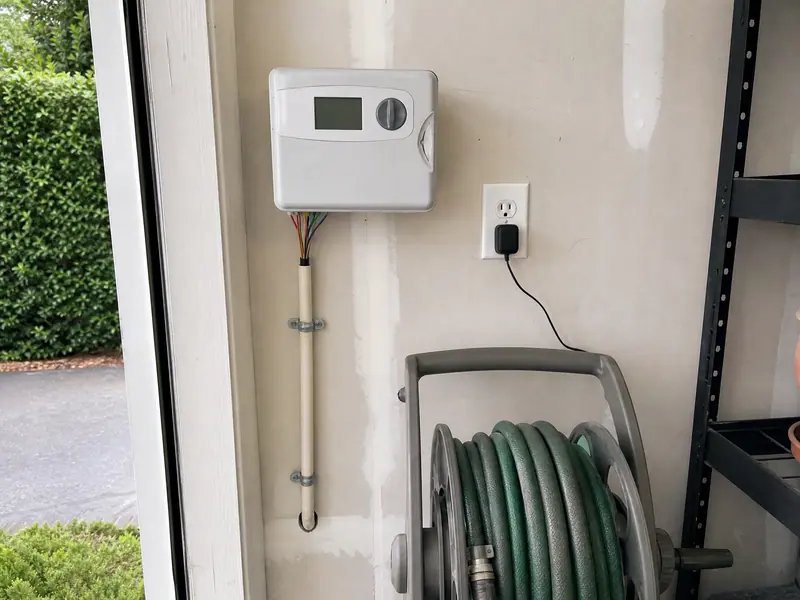
How much water does a smart controller save?
EPA says replacing a clock-based controller with a WaterSense labeled controller can save an average home up to 15,000 gallons a year. Its pages for each type give a narrower picture: a weather-based model saves nearly 7,600 gallons a year, and a soil moisture-based model more than 15,000 in a home with automatic irrigation.
Using the price per kilogallon built into EPA's calculator, $6.06, 7,600 gallons is about $46 a year and 15,000 about $91, by our arithmetic. Your own bill's rate, especially a summer or tiered rate, sets the real figure.
| Controller | Gallons saved a year | Dollars a year at $6.06 |
|---|---|---|
| Any WaterSense labeled controller | up to 15,000 | up to about $91 |
| Weather-based (WaterSense) | nearly 7,600 | about $46 |
| Soil moisture-based (WaterSense) | more than 15,000 | more than $91 |
| Clock timer, left as is | none; EPA says clock-timer homes use about 50% more water outdoors than homes with no system | none |
Source under the table: EPA WaterSense controller pages. Gallons are EPA's per-home figures; dollars are our arithmetic at EPA's assumed $6.06 a kilogallon; your rate will differ.
Weather-based or soil moisture: which should you get?
Either can earn the label. Weather-based controllers adjust run times from local weather and landscape conditions; soil moisture-based controllers, also called soil moisture sensors, skip watering when the soil is still wet. EPA says some controllers use both, and those must be certified under both specifications to carry the label.
EPA's soil moisture figure is the larger one, but it depends on sensors placed and kept in good order. Weather-based models need correct settings for plant type, soil and sun in each zone.
The water district's clip shows a weather-based controller using an on-site sensor for sun, wind and rain to change run times through the seasons. Its savings figure is the district's own. Look for the WaterSense label on the box.
Why doesn't a new controller always save that much?
Because EPA's savings assume "proper installation, programming, and maintenance". A labeled controller set to water every zone the same, or wired to a system with broken heads, will fall short. EPA's Sprinkler Spruce-Up page says leaks and broken heads can waste up to 25,000 gallons and $280 over a six-month season, and valves that do not close can seep water when the system is off.
Fix leaks first, then set each zone. If runoff starts before the plants get enough, EPA's Watering Tips suggest cycle-and-soak: shorter runs with breaks.
Can you install a smart controller yourself?
Often, when it replaces a plug-in timer on the same low-voltage valve wires. Label each wire before you remove the old timer. If the controller must be hard-wired to line voltage, or a new outlet is needed, that is a licensed electrician's job. If you are unsure about the valves, EPA suggests an irrigation professional certified by a WaterSense labeled program.
Will my water utility help pay for it?
Some do. Seattle-area utilities' program at savingwater.org paid up to $100, at $10 for each zone that works, toward a WaterSense timer, and Austin Water offered up to $40 for a hose-end timer, both when checked on 11 Nov 2026. A Denver Water controller rebate seen in old search listings was not on its current outdoor page. See water utility rebates for more, and check with your water utility before you buy.
A controller pairs well with drip on the beds; compare every yard option on the yard page.
When the answer flips
- You water by hose only: skip the controller; a hose-end timer or a rain barrel is the better step.
- Your system has leaks or tilted heads: fix them first, since up to 25,000 gallons a season can go there.
- The controller needs hard wiring: still worth it, but the wiring is a licensed electrician's job.
- Your yard gets steady summer rain and you already shut the timer off by hand: the saving will be smaller.
What to buy or ask a plumber
- Look for the WaterSense label; for a dual-sensor model, both certifications.
- Ask whether it replaces your timer on the existing low-voltage wires.
- Ask an irrigation pro certified by a WaterSense labeled program to check heads and valves first.
- Ask your water utility for a controller rebate before buying; programs pause and change.
Also asked
Does a smart controller work without Wi-Fi?
EPA's labels cover weather and soil moisture control, not internet features. Some models use an on-site sensor rather than an online forecast; check how a model gets its data before you buy.
Is a rain sensor the same as a smart controller?
No. A rain sensor stops a timer during rain; a WaterSense controller adjusts the schedule from weather or soil moisture. We found no EPA savings figure for rain sensors alone.
How often should I change the schedule on a smart controller?
A labeled controller adjusts for you, but EPA still advises adjusting irrigation for the seasons and checking the system monthly for leaks and clogged heads.
Does a smart controller help in winter?
Only if your system runs then. In freezing climates, the system is usually shut off and drained, and the controller does nothing until spring.
How we reached this
The savings come straight from three EPA WaterSense product pages, updated in March 2026. Dollars were worked out by us from EPA's $6.06 price, which may sit below your summer rate. We left out controller prices and brand names. The rebates were read on 11 Nov 2026; Denver's controller rebate could not be confirmed on its live page, so it is not counted. Winter shutdown is general practice in cold climates, not an EPA figure.
Sources
- US EPA WaterSense — WaterSense Labeled Controllers · up to 15,000 gallons; two types; dual certification · checked 11 Nov 2026
- US EPA WaterSense — Weather-Based Irrigation Controllers · nearly 7,600 gallons a year · checked 11 Nov 2026
- US EPA WaterSense — Soil Moisture-Based Irrigation Controllers · more than 15,000 gallons a year · checked 11 Nov 2026
- US EPA WaterSense — Sprinkler Spruce-Up · clock-timer homes use 50% more; 25,000 gallons and $280 from leaks · checked 11 Nov 2026
- US EPA WaterSense — Watering Tips · cycle-and-soak; seasonal adjustment · checked 11 Nov 2026
- US EPA WaterSense — How the WaterSense Calculator Works · $6.06 per 1,000 gallons · checked 11 Nov 2026
- Saving Water program — Sprinkler Timer Replacement Rebate · $10 a zone, up to $100 · checked 11 Nov 2026
- Austin Water — Rebates, Tools & Programs · hose-end timer up to $40 · checked 11 Nov 2026
More from the yard
 Drip irrigation or sprinklers for your yard?Put beds, shrubs and trees on drip; keep lawn on sprinklers with pressure-regulating heads and fixed leaks.Drip beds5,100+ gal
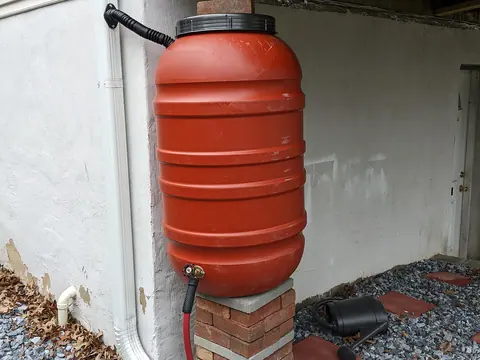 Is a rain barrel legal and worth it?Worth it for beds where your state allows it; check your state's limit first, and never drink it or plumb it in.Check rules620 gal
 Should you send washer water to the yard?Worth it for watering trees and shrubs where your state allows a simple washer system; check the rule first.Check rules6,000 gal