Water pressure · a decision
Do you need a pressure reducing valve?
A pressure reducing valve earns its place only when a gauge says so: EPA says fixtures work best at 45 to 60 psi, so test at a hose bibb before buying or adjusting anything.
45–60 psi
the incoming pressure range at which EPA says household fixtures work best (Home Maintenance, updated June 16, 2026)
Put a gauge on a hose bibb with all water off; if it reads well above 60 psi, have a plumber adjust or fit a PRV.
Worked out by Where Your Gallons Go from 8 dated sources · numbers checked 11 November 2026
The answer by situation
- Gauge reads 45 to 60 psiLeave itThat is the range EPA says household fixtures work best in.
- Gauge reads well above 60 psiPlumber: PRVEPA's advice is to have a professional adjust or install a PRV to hold about 60 psi.
- PRV fitted, gauge still reads highHave it checkedAdjusting or replacing a PRV is a plumber's job, and EPA lists irregular pressure among leak causes.
- Gauge reads well below 45 psiLook for leaksEPA's next step for low pressure is a leak hunt, starting with the meter.
- Sprinkler zones run at 60 psi or moreRegulate themWaterSense spray bodies with built-in regulation save about 5,600 gallons a year in that case.
How do you test your home's water pressure?
With a screw-on gauge at an outdoor hose bibb, and every fixture in the house turned off. That is the method on EPA's Home Maintenance page, last updated June 16, 2026, and it is a homeowner job: no tools beyond the gauge, and nothing to take apart.
Thread the gauge on hand-tight, open the bibb, and read the needle. Make sure nothing runs inside, irrigation timer and softener included, since any flow pulls the reading down. A second reading at another time of day shows whether supply pressure swings.
What pressure is too high for a house?
EPA does not set a ceiling, but it gives a target. Its words: fixtures operate best when incoming pressure is between 45 and 60 psi, and if the reading is much higher, "you may want to have a professional adjust or install a PRV to help maintain water pressure at 60 psi." Local plumbing codes set a maximum pressure and may require a PRV and expansion control; your plumber or code office will know your rule.
Pressure matters for leaks, too. EPA's February 2026 Know Your Flow guide lists irregular water pressure beside old pipes, corrosion and cold among the causes of household leaks.
Does lowering pressure save water?
Indoors, probably a little: flow limits are measured at set test pressures, so a house far above them can push more than the rating through an open tap. We found no national gallon figure for that.
Outdoors the numbers are firmer. EPA says WaterSense labeled spray sprinkler bodies, which regulate pressure themselves, cut about 5,600 gallons and $60 from a year's bill (EPA page updated March 6, 2026) for an average household watering 50,500 gallons outdoors where system pressure is 60 psi or higher. Drip zones need lower pressure still: the Southern Nevada Water Authority's rebate page says a regulator usually holds them at 20 to 40 psi. The drip or sprinklers page compares the two.
| Item | Test or target pressure | Gallons | Source |
|---|---|---|---|
| Federal showerhead limit, made after Jan 1, 1994 | 80 psi flowing | 2.5 a minute | eCFR 430.32(p) |
| WaterSense showerhead | 20, 45 and 80 psi flowing | 2.0 a minute | WaterSense spec v1.1 |
| Federal bathroom and kitchen faucet limit, made after Jan 1, 1994 | 60 psi flowing | 2.2 a minute | eCFR 430.32(o) |
| WaterSense bathroom faucet, maximum and minimum | 60 psi and 20 psi flowing | 1.5 and 0.8 a minute | WaterSense faucet spec |
| EPA's target for incoming house pressure | 45 to 60 psi static | not given | EPA Home Maintenance |
| Pressure-regulating sprinkler bodies (WaterSense) | at or above 60 psi | about 5,600 a year saved | EPA |
Source under the table: Federal limits, WaterSense specifications and EPA Home Maintenance. Each limit is tested at a flowing pressure, not the static pressure your gauge reads with everything off; the gallons are each source's own figure.
What do low readings mean?
If the gauge reads much lower than 45 psi, EPA says to look for a leak. Run the meter leak test first. Scale can matter too: the USGS notes that long-term hard water flow can narrow pipes and lower pressure, which the water softener page touches on. If the whole street has low pressure, the answer sits with your water utility.
Who installs or adjusts a PRV?
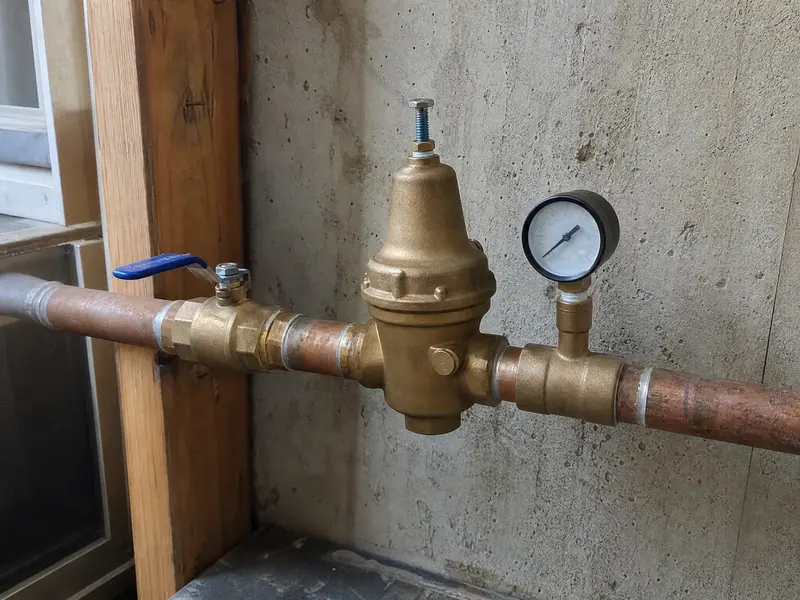
A plumber. The valve sits on the main line where water enters the house, so fitting one means shutting the main and cutting into the supply pipe. Adjusting one looks simple, a screw and a lock nut, but EPA's own wording puts the job with a professional, and your code may call for expansion control at the same time. Bring your readings and their times; the wider room is covered under leaks and pressure.
When the answer flips
- Your gauge reads within 45 to 60 psi: no PRV is needed for EPA's purposes.
- You already have a PRV and readings creep above 60 psi: it may need adjusting or replacing, which is plumbing work.
- Irrigation runs at 60 psi or more: pressure-regulating spray bodies are the cheaper first fix outdoors, worth about 5,600 gallons a year.
What to buy or ask a plumber
- Buy a hose-thread pressure gauge and take readings with every fixture off, at two times of day.
- Ask the plumber what static pressure they will set and how they will test it afterward.
- For sprinklers, look for WaterSense labeled spray sprinkler bodies, or a pressure regulator on drip zones.
Also asked
Should I test water pressure with a faucet running?
No. EPA's test is with all water off, which gives static pressure. Flow ratings on showerheads and faucets are measured while water flows, which is a different number.
What is the maximum water pressure allowed in a house?
That is set by your local plumbing code, which may also require a PRV and expansion control above its limit. Ask your plumber or code office; EPA's own advice is to stay near 60 psi.
What gauge do I need for a pressure test?
One that threads onto an outdoor hose bibb and reads in psi.
Does a PRV make my shower weaker?
It can feel softer if pressure was very high before. WaterSense showerheads must pass minimum flow and spray force tests at 20 psi, well below a PRV set near 60.
How we reached this
The target range and the PRV advice are EPA's, from its Home Maintenance page updated June 16, 2026; EPA frames them as advice for fixtures, not a legal limit. Official plumbing code text on maximum pressure or expansion control was not available to confirm on 11 Nov 2026, so this page sends you to your plumber or code office. Flow ratings come from the federal rule and the WaterSense showerhead (2018) and faucet (2007) specifications; sprinkler savings are EPA's household averages.
Sources
- US EPA WaterSense — Home Maintenance · 45 to 60 psi, gauge test, PRV advice, low-pressure leak advice · checked 11 Nov 2026
- US EPA — Know Your Flow guide (February 2026) · irregular pressure as a leak cause · checked 11 Nov 2026
- eCFR — 10 CFR 430.32 Energy and water conservation standards · showerhead and faucet limits and test pressures · checked 11 Nov 2026
- US EPA — WaterSense Specification for Showerheads, Version 1.1 · 2.0 gpm tested at 20, 45 and 80 psi · checked 11 Nov 2026
- US EPA — High-Efficiency Lavatory Faucet Specification · 1.5 gpm at 60 psi, 0.8 gpm at 20 psi · checked 11 Nov 2026
- US EPA WaterSense — Spray Sprinkler Bodies · 5,600 gallons and $60 a year at 60 psi or more · checked 11 Nov 2026
- Southern Nevada Water Authority — Water Smart Landscapes Rebate · drip regulator at 20 to 40 psi · checked 11 Nov 2026
- USGS Water Science School — Hardness of Water · scale narrowing pipes and lowering pressure · checked 11 Nov 2026
More from the leaks and pressure
 How do you run a water meter leak test?Read the meter, use no water for two hours, read it again; any movement means a probable leak to track down.Test now9,300+ gal
 Is a dripping faucet worth fixing now?Fix it this week: at one drip a second, EPA counts more than 3,000 gallons a year down the drain.Fix now3,000+ gal
 Leak sensor or automatic shutoff valve: which do you need?Start with plug-in sensors at the heater, washer and sinks; add a main-line shutoff if a burst would cost dearly.Depends4,300 gal a day