Tub and shower · a decision
Bath or shower: which uses less water?
On bath vs shower water usage, the shower wins for most people: EPA's archived figures put a full tub at up to 70 gallons and a 5-minute shower at 10 to 25.
54 gal
gallons saved each time an 8-minute 2.0 gpm shower replaces a full 70-gallon bath (our arithmetic)
Shower for everyday washing; a full bath uses about as much as a 35-minute shower on a 2.0 gpm head.
Worked out by Where Your Gallons Go from 7 dated sources · numbers checked 11 November 2026
The answer by situation
- Everyday wash, any head at 2.5 gpm or lessShowerAn 8-minute shower at 2.0 gpm uses 16 gallons against up to 70 for a full tub.
- Showers that run past half an hourBathAt 2.0 gpm a shower passes 70 gallons at 35 minutes; at 2.5 gpm, at 28.
- Old head at 5.5 gpmSwap the headIt passes a full tub in about 13 minutes.
- Two small children in one shallow bathDependsShared water halves the gallons per child; a half-full tub is still about 35.
- Water still runs from the spout in shower modeFix the diverterThat water is lost on every shower, by EPA's checklist.
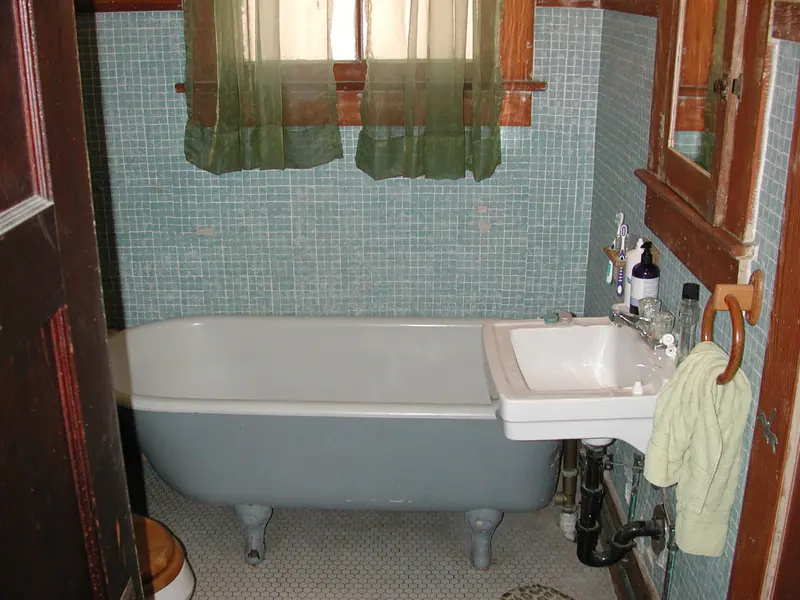
How much water does a bath use compared with a shower?
A full bathtub can take up to 70 gallons, and a 5-minute shower uses 10 to 25, according to EPA's January 2017 archived page. Those are older figures; we found them only on EPA's frozen 2017 site, not on its current pages. The low end of the shower range fits today's heads: 2.0 gallons a minute for 5 minutes is 10 gallons, our arithmetic.
| Choice | Gallons each time | Gallons a year, once a day |
|---|---|---|
| Full tub (EPA, 2017) | up to 70 | 25,550 |
| Half-full tub | 35 | 12,775 |
| 5-minute shower (EPA, 2017 range) | 10 to 25 | 3,650 to 9,125 |
| 8-minute shower at 2.5 gpm | 20 | 7,300 |
| 8-minute shower at 2.0 gpm | 16 | 5,840 |
| 8-minute shower at 1.8 gpm | 14.4 | 5,256 |
Source under the table: EPA archived page, January 2017; WaterSense flow limits. The tub and 5-minute range are EPA's 2017 figures; every other row is our arithmetic, flow rate times minutes, times 365 for one person; the half tub is our example.
Read the last column as a ceiling for daily habits. Someone who swaps one full bath a week for an 8-minute 2.0 gpm shower saves about 54 gallons a week, or about 2,810 a year (our arithmetic).
How long can a shower run before it uses more than a bath?
About 35 minutes on a 2.0 gpm head and 28 minutes on a 2.5 gpm head, if the tub would hold 70 gallons. Divide the tub's gallons by the head's flow rate to get your own break-even. A half-full tub of about 35 gallons moves the break-even to about 17½ minutes at 2.0 gpm, so a shallow bath can beat a long shower.
Does the showerhead change the answer?
Yes, more than anything else. An old head at 5.5 gallons a minute, the high end cited on an archived Energy Saver page, fills the equal of a full tub in about 13 minutes. EPA's Showerheads page says WaterSense heads save the average family 2,700 gallons a year; the showerhead swap page has the bucket test.
Which uses more hot water?
Whichever uses more gallons, since both draw mostly hot water. Showers also lose cold water at the start while the line warms up; across all fixtures, EPA's hot water delivery guide (May 2026) counts 6.35 gallons per household per day lost to that wait. If that wait is long, the hot water pages look at the pipes.
What leak hides in a tub-and-shower combo?
The diverter, the part that sends water up to the head. EPA's leak checklist says to run the tub, switch to the shower, and watch the spout: if a strong stream keeps coming out of it, the diverter may need replacing. A head that drips after shutoff is a separate leak, covered on dripping faucet.
When the answer flips
- Your showers run longer than 35 minutes on a 2.0 gpm head: a full bath uses less.
- You fill the tub only a third of the way: about 23 gallons, it beats a shower longer than about 12 minutes at 2.0 gpm (our arithmetic).
- The showerhead is an old high-flow model: swap it first, then compare again.
- Someone needs a bath for comfort or care: the gallons are a cost to weigh, not a rule.
What to buy or ask a plumber
- Check the gallons a minute printed on your showerhead; WaterSense heads are 2.0 or less.
- If a tub fills slowly or the diverter leaks, ask a plumber whether the valve cartridge or the spout is the part to replace.
- If buying a new tub, ask its gallon capacity to the overflow; that is your real full-bath number.
- Ask whether a new shower valve limits the top temperature, if scalding is a concern in your home.
Also asked
How many gallons does a standard bathtub hold?
EPA's 2017 figure for a full tub is up to 70 gallons. Your tub's own capacity to the overflow drain, listed by its maker, is the better number for your home.
Is a quick bath better than a long shower?
It can be. A third-full tub of about 23 gallons uses less than a 2.0 gpm shower that runs longer than about 12 minutes, our arithmetic.
Where do baths show up in household water use?
EPA's indoor breakdown, from a 2016 Water Research Foundation study, folds baths into "other", 8% of indoor use, while showers alone are 20%. EPA's showerhead page puts a typical family's shower water near 40 gallons daily.
Does a rain-style showerhead change the bath comparison?
Only through its flow rating. A WaterSense rain head still has to be 2.0 gpm or less, so the same break-even math applies.
See the bathroom page for how this compares with toilet and faucet decisions in gallons a year.
How we reached this
EPA no longer publishes a bath-versus-shower figure on its current pages, so the 70-gallon tub and the 10-to-25-gallon shower come from EPA's own January 2017 archived site, and we say so wherever they appear. The break-even minutes, the half and third tubs and the yearly totals are our arithmetic, checked 11 Nov 2026. Tubs vary widely in size and few are filled to the brim, and we did not price the hot water, which depends on your heater and fuel.
Sources
- US EPA — Simple Steps to Save Water, archived copy of January 19, 2017 · full tub up to 70 gallons, 5-minute shower 10 to 25 · checked 11 Nov 2026
- US EPA WaterSense — Showerheads · 2,700 gallons a year, nearly 40 gallons a day in showers · checked 11 Nov 2026
- US EPA WaterSense — How We Use Water · showers 20%, other (including baths) 8% of indoor use · checked 11 Nov 2026
- US DOE Energy Saver — Reduce Hot Water Use, archived copy of January 1, 2026 · older heads up to 5.5 gpm · checked 11 Nov 2026
- US DOE Energy Saver — Lower Water Heating Temperature, archived copy of January 1, 2026 · 120°F, scald hazard at 140°F · checked 11 Nov 2026
- US EPA — Best Practices for Efficient Hot Water Delivery in Homes, May 2026 · 6.35 gallons a day waiting for hot water · checked 11 Nov 2026
- US EPA — Detect and Chase Down Leaks checklist · tub spout diverter check · checked 11 Nov 2026
More from the bathroom
 Should you replace an old toilet?Replace it if it was made before 1994; keep a working 1.6 gpf toilet unless it leaks or you remodel.Replace10,640 gal
 Running toilet: fix it or replace it?Fix a running toilet this week; replace the whole toilet only if it is a pre-1994 model or the china is cracked.Fix now200 gal a day
 Dual flush or single flush: which saves more?Either works; pick dual flush only if its full flush is 1.28 gpf or less and your household uses the half button.Depends1,530 gal
 Is a low-flow showerhead swap worth it?Swap a head that fills a gallon in under 20 seconds for a WaterSense model rated 2.0 gpm or less.Swap it2,700 gal
 Should you swap your bathroom faucet aerator?Screw on a 1.5 gpm WaterSense aerator if the faucet is marked 2.2 gpm or unmarked; the faucet can usually stay.Swap it700 gal