Leak devices · a decision
Leak sensor or automatic shutoff valve: which do you need?
A smart leak detector and an automatic water shut off valve do different jobs: a sensor warns about water where it pools, while a main-line device watches flow and can close the supply.
4,300 gal a day
gallons a day a stuck toilet fill valve can waste, the kind of steady flow a monitor flags (EPA, Feb 2026)
Start with plug-in sensors at the heater, washer and sinks; add a main-line shutoff if a burst would cost dearly.
Worked out by Where Your Gallons Go from 6 dated sources · numbers checked 11 November 2026
The answer by situation
- Renting, or a small budgetSpot sensorsBattery or plug-in sensors at the water heater, washer and sinks need no plumbing and catch water where it lands.
- House where a burst would do costly damageMain-line shutoffInsurer-industry data put water and freezing claims at $15,400 each on average (III).
- You want to find slow, hidden leaksFlow monitorA main-line monitor sees continuous flow, such as a fill valve that can waste 4,300 gallons a day.
- Home with fire sprinklersPlumber onlyA device must never sit upstream of the sprinkler line or cut its water supply.
- Leaks from the roof or AC drainSpot sensorsFlow devices cannot see water that never passed through the meter.
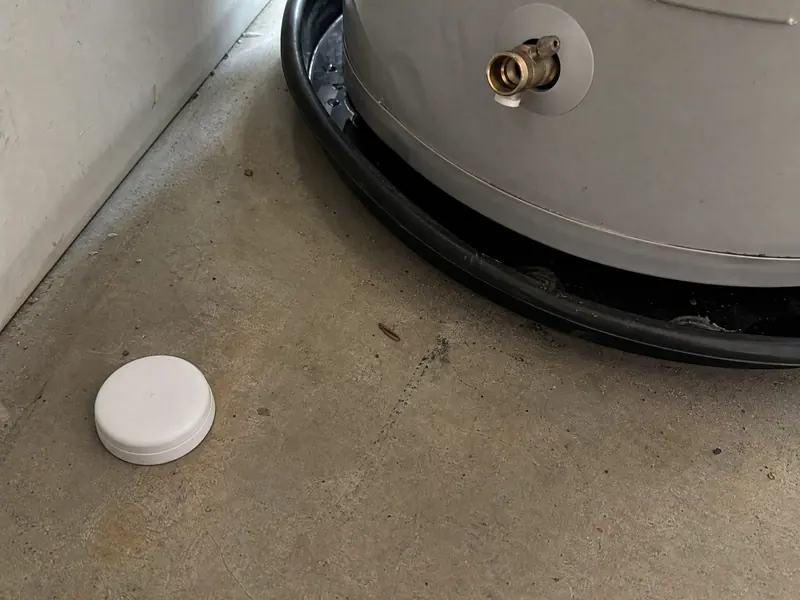
What is the difference between a leak sensor and a shutoff valve?
Where they sit and what they can see. EPA's February 2026 Know Your Flow guide sorts the devices into three groups:
- Point-of-use sensors sit on the floor by one appliance and alarm when they get wet.
- In-line monitors at a fixture watch the flow to one appliance or toilet.
- Point-of-entry devices go on the main line, at the meter or where water enters the house. Some are in-line and usually include a built-in shutoff valve; others clamp outside the pipe and only monitor.
Only devices with an automatic shutoff can stop the supply in a catastrophic leak; a spot sensor just warns.
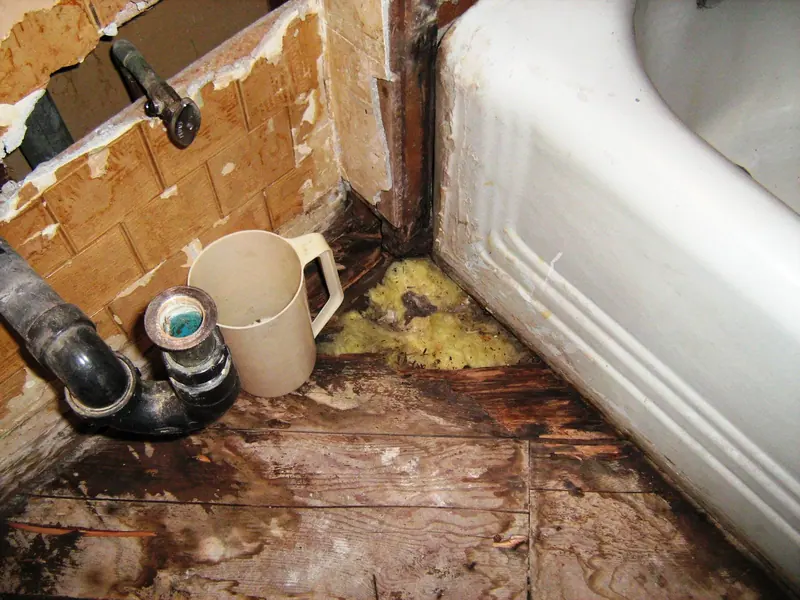
Which leaks does each type miss?
Each misses something. A main-line flow device cannot see a leak that has nothing to do with water use: EPA's examples are condensate from an air conditioner, a roof leak, and water pooling under a sink from a drain pipe. A floor sensor, in turn, knows only the spot it sits on, not a pinhole leak inside a wall.
So the two types complement each other rather than compete.
Is an automatic shutoff valve worth it?
That depends on what a burst would cost. The Insurance Information Institute, an insurer-industry research body, reports from ISO data that water damage and freezing claims averaged $15,400 per claim in 2019 to 2023, and that about one in 60 insured homes claimed each year in 2018 to 2020; the ledger's 1.5 per 100 is III's figure for the later years. EPA's Fix a Leak Week page says 9% of homes have leaks of 50 gallons or more a day.
| Situation | Gallons | Dollars | Source |
|---|---|---|---|
| Toilet fill valve stuck open | 4,300 daily | as much as $1,400 monthly | EPA, Feb 2026 |
| Homes in the leakiest 9% | 50+ a day | not given | EPA Fix a Leak Week |
| Water damage or freezing claim, average | not given | $15,400 | III, citing ISO |
| Claims per 100 insured homes a year | not given | 1.5 | III, citing ISO, 2019 to 2023 |
| Expected water-claim loss per insured home a year | not given | about $231 | our arithmetic |
| Flow sensor rebate, San Antonio | not given | $150 | SAWS, checked 11 Nov 2026 |
Source under the table: EPA Know Your Flow fact pages and Insurance Information Institute. Each row is the source's own figure except the expected-loss row, which is our arithmetic (1.5 claims per 100 house-years times $15,400) and only an average across insured homes.
Those III figures leave out Alaska, Texas and Puerto Rico. Some insurers offer discounts for homes with a leak or flow device, EPA says, without naming an amount; ask yours.
Can you install a leak shutoff valve yourself?
Sensors and clamp-on monitors, often yes. In-line devices on the main line may need a plumber, EPA says, and some makers require one. San Antonio Water System's flow sensor rebate pays $150, as of 11 Nov 2026, for approved models with automatic or remote shutoff, but only when a plumber installs them and the application arrives within 60 days of purchase; funds are limited. Any hard-wired power or controller wiring is a licensed electrician's job.
What if your home has fire sprinklers?
Then placement is a safety question. EPA tells buyers to make sure a device will not interfere with or stop water to home fire sprinklers, and the SoCal WaterSmart FAQ is blunter: never install one on the main service line upstream of the sprinkler system. Have a licensed plumber fit it on the domestic line after the split.
What about shutting the water off when you travel?
A manual main valve does that for free, if you know where it is and it turns; a softener in line then needs bypassing or leaving on, which the store article below covers. Never close a valve that also feeds fire sprinklers. Before buying anything, a meter leak test and a fixed dripping faucet start you from a tight house; leaks and pressure covers the rest of this room and water utility rebates the money.
When the answer flips
- Your house has fire sprinklers: any main-line device becomes a plumber's job, placed on the domestic line only.
- Your biggest risk is the roof, AC drain or a sink drain: spot sensors help and a flow monitor will not.
- Your utility runs a rebate, as San Antonio does at $150: check its approved list and install rules before buying.
What to buy or ask a plumber
- Ask for certification to ANSI/CAN/IAPMO Z1349; there is no WaterSense label for these devices.
- Ask the plumber where the domestic line splits from any fire sprinkler line, and to install only after it.
- Ask what flow the monitor detects and how long it waits before closing the valve.
- Ask your insurer whether a leak or flow device earns a discount, and which types qualify.
Also asked
Will a leak detector lower my homeowners insurance?
Possibly. EPA says some insurers offer discounts for homes with a leak detection or flow monitoring device, but gives no amount. Ask your insurer before you buy.
Can a flow monitor catch a slow toilet leak?
Many can, since a leaking toilet means water flows when no one is using any. Detection thresholds on one utility's approved list range from 0.1 to 0.3 gallons a minute, so check the figure for any model.
Is there a WaterSense label for leak detectors?
No. EPA says these devices are not eligible and points to ANSI/CAN/IAPMO Z1349 certification instead. Results quoted in its guide, such as 60% of one maker's in-line buyers finding unknown leaks, are manufacturer data.
Do I need a smart device if my utility has smart meters?
Not necessarily, but EPA notes utility meter alerts can lag by days, so an in-home device usually reports sooner.
How we reached this
Device types, blind spots, the sprinkler caution and the certification point all come from EPA's Know Your Flow guide of February 2026, with the sprinkler rule worded most firmly by the SoCal WaterSmart program. Claim costs are the Insurance Information Institute's, from ISO data; its table header and footnote disagree on the years (2019 to 2023 or 2020 to 2024), and the one-in-60 figure covers 2018 to 2020. Our $231 is a rough average, not a premium. Rebate terms are San Antonio's as shown on 11 Nov 2026 and will change. No device was tested by us.
Sources
- US EPA — Know Your Flow: A WaterSense Guide to Leak Detection and Flow Monitoring Devices (February 2026) · device types, blind spots, sprinkler caution, Z1349, insurer discounts, AMI lag · checked 11 Nov 2026
- US EPA — Know Your Flow summary (February 2026) · stuck fill valve, 4,300 gallons a day · checked 11 Nov 2026
- US EPA WaterSense — Fix a Leak Week · 9% of homes leak 50+ gallons a day · checked 11 Nov 2026
- Insurance Information Institute — Facts + Statistics: Homeowners and renters insurance · $15,400 average claim, 1.5 per 100 house-years, one in 60 homes · checked 11 Nov 2026
- San Antonio Water System — Residential Flow Sensor Rebate · $150, plumber install, 60-day window, detection thresholds · checked 11 Nov 2026
- SoCal WaterSmart — Flow Monitoring Device FAQ · never upstream of the fire sprinkler line · checked 11 Nov 2026
More from the leaks and pressure
 How do you run a water meter leak test?Read the meter, use no water for two hours, read it again; any movement means a probable leak to track down.Test now9,300+ gal
 Is a dripping faucet worth fixing now?Fix it this week: at one drip a second, EPA counts more than 3,000 gallons a year down the drain.Fix now3,000+ gal
 Do you need a pressure reducing valve?Put a gauge on a hose bibb with all water off; if it reads well above 60 psi, have a plumber adjust or fit a PRV.Test first45–60 psi