Clothes washer · a decision
Should you replace an old washing machine?
A washing machine uses about 20 gallons a load if it is a standard model and 14 if it is ENERGY STAR certified, so the water case for scrapping a working one is real but modest.
1,800 gal
gallons a year saved by a 14-gallon ENERGY STAR washer over a 20-gallon standard one at 300 loads (our arithmetic)
Keep a working washer; when it fails, buy ENERGY STAR, which uses about 14 gallons a load instead of 20.
Worked out by Where Your Gallons Go from 6 dated sources · numbers checked 11 November 2026
The answer by situation
- Washer works, any typeKeepSwapping saves about 1,800 gallons a year, near $11 of water at EPA's $6.06 rate (our arithmetic).
- Washer has failed or needs a big repairBuy ENERGY STARA certified full-size model uses 14 gallons a load against 20 for a standard one.
- Old top-load agitator machineLean front-loadCertified front-loaders use about 50% less energy and water than a top-load agitator washer.
- Big household, 600 loads a yearReplace soonerThe gap doubles to about 3,600 gallons a year (our arithmetic).
- Most loads washed hotCount energyAbout 90% of a washer's energy goes to heating the water.
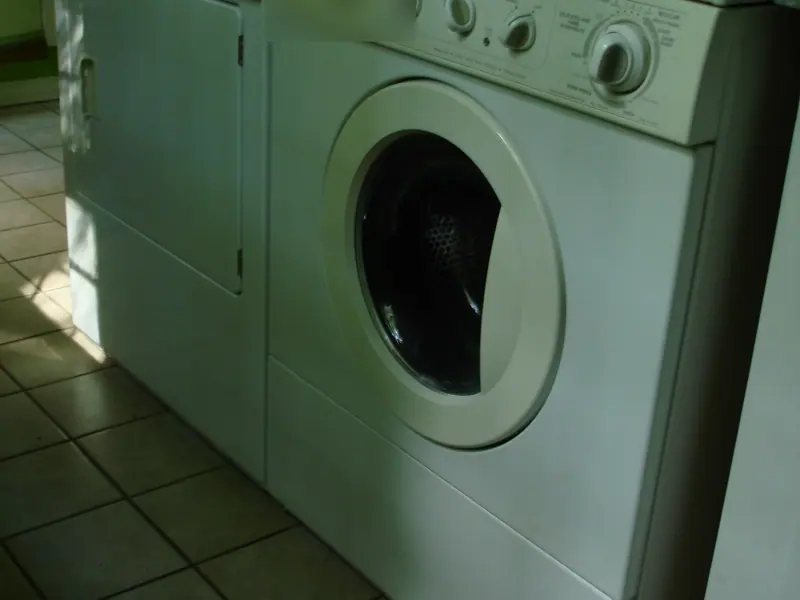
How much water does a washing machine use per load?
About 20 gallons for a standard full-size machine and 14 for one that has earned the label, according to ENERGY STAR's clothes washer page. The same page says certified washers use about 30% less water and 20% less energy than regular ones, and that the average family runs about 300 loads a year.
Laundry is a large slice of indoor use, as the kitchen and laundry overview shows. EPA's How We Use Water chart, drawn from the Water Research Foundation's 2016 end-use study, puts the clothes washer at 17% of a single-family home's indoor water, behind toilets, showers and faucets.
| Machine | Per load (gal) | Per year (gal) | Water and sewer per year |
|---|---|---|---|
| Standard full-size | 20 | 6,000 | $36.36 |
| ENERGY STAR full-size | 14 | 4,200 | $25.45 |
| Difference, 300 loads | 6 | 1,800 | $10.91 |
| Difference, 600 loads | 6 | 3,600 | $21.82 |
Source under the table: ENERGY STAR Clothes Washers. Our arithmetic: ENERGY STAR's gallons per load times its 300 loads a year; dollars price water and sewer the way EPA's WaterSense calculator does, at $6.06 a kilogallon.
Is it worth replacing a working washer just to save water?
For most homes, no. Eleven dollars a year of water will not repay a new machine, and the table above counts water only. Energy is where the bigger money sits: ENERGY STAR puts lifetime energy-cost savings at about $530 (checked 11 Nov 2026), and says roughly 90% of the energy a washer uses goes into heating its water.
So the better trigger is failure. When a repair quote arrives, weigh it against a certified machine, the way the replace now or when it breaks page sets out for any fixture.
Front-load or top-load: which uses less water?
Front-loaders, as a rule. ENERGY STAR says its certified front-load models use about 50% less energy and water than a top-load agitator washer, and about 25% less than a top-load impeller machine. If the old washer is an agitator top-loader, the real saving is larger than the 14-versus-20 average suggests.
The label rules show the same gap. For washers over 2.5 cubic feet, the ENERGY STAR criteria changed on April 22, 2021 and cap the Integrated Water Factor at 3.2 for front-loaders and 4.3 for top-loaders. That factor is gallons per cycle for each cubic foot of drum, so lower is better.
| Limit | Water factor ceiling | Gallons per cycle | Gallons a year |
|---|---|---|---|
| Federal, top-load standard, made since Jan 1, 2018 | 6.5 | 26.0 | 7,800 |
| Federal, front-load standard, made since Jan 1, 2018 | 4.7 | 18.8 | 5,640 |
| ENERGY STAR top-load over 2.5 cu ft | 4.3 | 17.2 | 5,160 |
| ENERGY STAR front-load over 2.5 cu ft | 3.2 | 12.8 | 3,840 |
Source under the table: eCFR 10 CFR 430.32(g) and ENERGY STAR criteria. Our arithmetic: each Integrated Water Factor ceiling times a 4.0 cubic foot drum, then times 300 loads; real machines often test below their ceiling.
Do federal rules make you replace an old washer?
No. The washer standards in 10 CFR 430.32 apply to clothes washers made on or after January 1, 2018, not to machines already in a laundry room. The same section lists a new efficiency metric for washers made on or after March 1, 2028; that tier could still be revised, and it will not touch the washer you own.
What should you check when the new machine goes in?
The water connections. Close both supply valves before the old machine is pulled, and drain the hoses into a bucket. If the valves are stiff, weep, or will not close fully, have them replaced while the box is open; that is plumbing work if you are unsure. A new washer is a good moment to inspect hoses too, since the machine will sit on them for years.
Where state rules allow, a washer's drain can also feed the yard. The laundry to landscape greywater page covers which states permit it and on what terms.
When the answer flips
- Your old washer is a top-load agitator: certified front-loaders use about half the water, so replacing a working one starts to make more sense.
- You run far more than 300 loads: at 600 a year the water gap is about 3,600 gallons and $22 at EPA's rate.
- Your water and sewer price is well above EPA's $6.06 per 1,000 gallons: multiply the 1,800-gallon gap by your own rate.
- You wash almost everything cold: the energy half of the case shrinks, since most washer energy heats water.
What to buy or ask a plumber
- Look for ENERGY STAR certification, and compare the Integrated Water Factor on the spec sheet: lower means fewer gallons per cubic foot.
- Front-load or top-load: ask for the certified water factor of each model you are weighing.
- Ask the installer to shut both supply valves before disconnecting the old washer, and to replace any valve that will not close.
- Ask your water utility whether it lists a washer rebate; water utility rebates explains where to look.
Also asked
How do I work out a washer's gallons per cycle from its spec sheet?
Multiply the Integrated Water Factor by the drum's capacity in cubic feet. A 4.5 cubic foot front-loader at the 3.2 ENERGY STAR ceiling may use up to 14.4 gallons a cycle by that sum.
Does a high-efficiency top-loader use as much water as a front-loader?
Usually more. ENERGY STAR says its certified front-loaders use about 25% less energy and water than a top-load impeller washer, the type often sold as high efficiency.
How much water have washers saved since the 1990s?
A lot, by the 2026 Water Research Foundation study. Its June 2026 release, seen in an archived copy, reports that clothes-washer water use has fallen 67.6% since 1999.
Is a 300-load year typical?
It is ENERGY STAR's figure for the average family. Count a normal week of loads, multiply by 52, and use that number instead. A softener in the house adds its own regeneration water on top; the water softener page has that figure.
How we reached this
Gallons per load and the 300-load year are ENERGY STAR's figures as shown on its clothes washer page on 11 Nov 2026; the program does not say how it set the 20-gallon standard machine. Water factor ceilings are from the ENERGY STAR criteria (levels changed April 22, 2021) and the federal standard for washers made from January 1, 2018. Both ledgers are our sums, and the second uses a 4.0 cubic foot drum chosen only as an example. Dollars use EPA's assumed water-and-sewer price and leave energy out; ENERGY STAR gives energy savings only as a $530 lifetime figure. The 2028 federal tier and any proposal to change it were not checked further.
Sources
- ENERGY STAR — Clothes Washers · 14 and 20 gallons a load, 300 loads, front-load and agitator comparison, 90% of energy for heating · checked 11 Nov 2026
- ENERGY STAR — Clothes Washers Key Product Criteria · water factor ceilings, April 22, 2021 change · checked 11 Nov 2026
- eCFR — 10 CFR 430.32 Energy and water conservation standards · federal water factor limits from Jan 1, 2018 and the 2028 tier · checked 11 Nov 2026
- US EPA WaterSense — How We Use Water · 17% clothes washer share (WRF 2016 study) · checked 11 Nov 2026
- US EPA WaterSense — How the WaterSense Calculator Works · $6.06 per 1,000 gallons price assumption · checked 11 Nov 2026
- Water Research Foundation — Residential End Use Study update release, June 15, 2026 · 67.6% fall in clothes-washer use since 1999 · archived copy of 4 Oct 2026, checked 11 Nov 2026
More from the kitchen and laundry
 Dishwasher or hand washing: which uses less water?Run a full ENERGY STAR dishwasher rather than washing by hand; scrape plates and skip the pre-rinse.Use it8,400 gal
 What kitchen faucet flow rate should you choose?Keep a working 2.2 gpm faucet and shorten how long it runs; choose 1.8 gpm when you replace it.Habits first10 gal
 Does a water softener waste water?A softener is a hardness choice, not a water saver; if you have or need one, choose demand regeneration.Demand control~50 gal