Dishwasher · a decision
Dishwasher or hand washing: which uses less water?
A dishwasher uses less water than hand washing in most homes: a certified standard model is capped at 3.2 gallons a cycle, while a sink tap left running for five minutes pours about 10.
8,400 gal
gallons a year a certified dishwasher saves compared with washing by hand (ENERGY STAR, checked 11 Nov 2026)
Run a full ENERGY STAR dishwasher rather than washing by hand; scrape plates and skip the pre-rinse.
Worked out by Where Your Gallons Go from 6 dated sources · numbers checked 11 November 2026
The answer by situation
- You have a working dishwasherUse itA full load at 3.2 gallons or less beats a sink tap that runs about 10 gallons in five minutes.
- You rinse plates under the tap firstStopENERGY STAR says pre-rinsing adds water and energy; scraping food off is enough.
- You run it half emptyWait till fullSkipping one load a week saves the average family nearly 320 gallons a year (EPA).
- Your dishwasher is old but worksKeep itThe water gap to a new certified model is a few hundred gallons a year, worth about $2 at EPA's rate.
- No dishwasher, few dishesBasin washFill a basin or stopper the sink; the running tap is what burns the gallons.
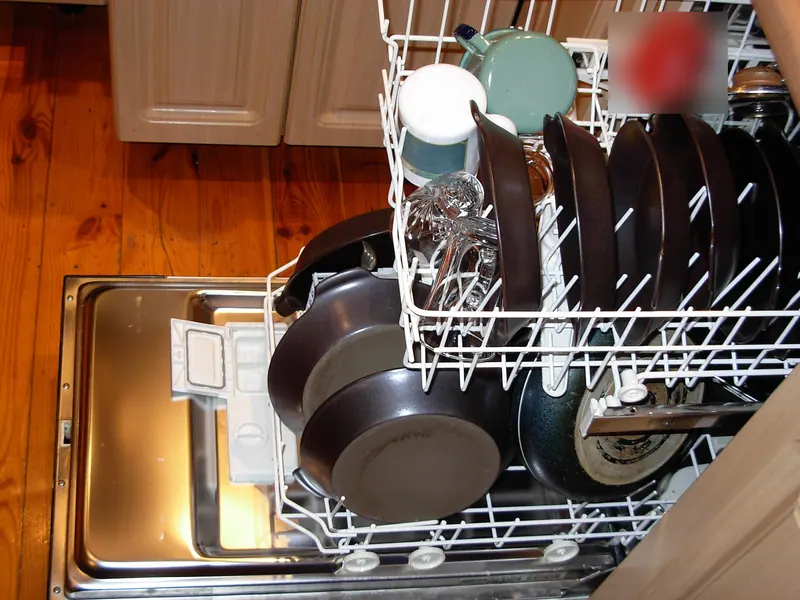
Does a dishwasher really use less water than hand washing?
Yes, by a wide margin. ENERGY STAR says a new certified dishwasher saves 8,400 gallons of water a year compared with washing by hand, and about $220 a year in utility bills, or $3,300 over the machine's life (figures checked 11 Nov 2026).
Those totals depend on how a typical person hand washes, and the program does not spell out its hand-washing assumptions on that page. The sink side of the sum is easy to picture, though: EPA's Statistics and Facts page says letting a faucet run for five minutes while washing dishes uses about 10 gallons. Two such sessions a day add up to 7,300 gallons a year, by our arithmetic.
How much water does a dishwasher use per cycle?
A standard-size ENERGY STAR model may use no more than 3.2 gallons per cycle and 240 kWh a year, under criteria effective July 19, 2023. Compact models are held to 2.0 gallons and 155 kWh.
The federal floor is looser. Under 10 CFR 430.32, standard dishwashers made on or after May 30, 2013 may use up to 5.0 gallons a cycle, and compact ones 3.5. Like every federal product limit, it covers machines made after the date, not the one already under your counter.
| Method | Gallons per load | Gallons a year | Water cost a year at $6.06 per 1,000 gal |
|---|---|---|---|
| ENERGY STAR compact, at its cap | 2.0 | 430 | $2.61 |
| ENERGY STAR standard, at its cap | 3.2 | 688 | $4.17 |
| Federal limit, standard model made since May 30, 2013 | 5.0 | 1,075 | $6.51 |
| Sink tap running five minutes per wash | 10 | 2,150 | $13.03 |
Source under the table: ENERGY STAR Dishwashers Key Product Criteria. Our arithmetic: gallons per load times the 215 cycles a year used in the DOE test; the sink row assumes the tap runs five minutes per wash, using EPA's 10-gallon figure.
The dollar column uses the water-and-sewer price built into EPA's WaterSense calculator, not your bill, and leaves out heating energy, which is most of the $220 ENERGY STAR quotes.
What happens to the federal limit in 2027?
That is unsettled. The CFR text still lists 3.3 gallons a cycle for standard dishwashers made on or after April 23, 2027, except models whose normal cycle runs 60 minutes or less. On May 16, 2025, DOE proposed rescinding those amended water limits, which would send the standard-size requirement back to the statute's 6.5 gallons. We found no final rule as of 11 Nov 2026, so treat the 2027 number as uncertain. The ENERGY STAR cap of 3.2 gallons is the figure to shop by either way.
Should you rinse dishes before loading them?
No. ENERGY STAR says rinsing first raises the total water and energy used, and that scraping food into the trash is enough. Much of that rinse water is hot, so it also costs heating energy; the hot water section covers where those gallons go.
Is it worth replacing an older dishwasher to save water?
Usually not on water alone. A standard machine at the 2013 federal limit uses about 387 more gallons a year than one at the ENERGY STAR cap, by the arithmetic in the table above, or about $2.35 of water at EPA's rate. Energy and repairs carry the decision, which is why the timing question on replace now or when it breaks applies here.
When it fails, buy certified; water utility rebates explains how to check for local money first.
When does hand washing still make sense?
When there is no machine, or only a few cups to do. The waste is the open tap: at the federal 2.2 gallon-a-minute cap for kitchen faucets, each minute it runs adds 2.2 gallons, so wash in a filled basin. The kitchen faucet flow page shows why minutes matter more than the faucet's rating.
When the answer flips
- You wash a handful of items in a filled basin and never open the tap: the machine's lead shrinks, though we found no published gallon figure for basin washing.
- You load the machine half full every night: each extra weekly load adds about 320 gallons a year, by EPA's count.
- You pre-rinse under hot running water: five minutes adds about 10 gallons per load, roughly three times what the certified machine itself uses.
What to buy or ask a plumber
- Look for ENERGY STAR certification and the gallons-per-cycle figure; 3.2 or less for standard size, 2.0 or less for compact.
- Check that the model is standard or compact to match how many dishes you really wash in a day.
- Ask the installer to fit the new machine to a working shutoff valve under the sink, and to shut the water off before disconnecting the old one.
- If the circuit or a hard-wired connection needs changes, that part is a licensed electrician's job.
Also asked
Is a compact dishwasher better for water than a full-size one?
Per cycle, yes: the ENERGY STAR cap is 2.0 gallons for compact models and 3.2 for standard ones. Per dish, it depends on how often you run it. A compact model run twice to clear what one standard load would hold uses more water.
How much water did dishwashers use before the 2013 rule?
The federal limit for standard models made on or after May 30, 2013 is 5.0 gallons a cycle. DOE's 2025 proposal names 6.5 gallons as the statutory level for standard-size machines. We did not confirm when that level first applied, so assume a pre-2013 machine uses 5.0 gallons or more.
Does running the dishwasher every night waste water?
Only if it is not full. EPA's figure is nearly 320 gallons a year saved when a family cuts one load a week by waiting for full racks.
Must I replace my dishwasher when federal limits change?
No. Federal dishwasher limits cover machines made on or after their dates, and California's older-home retrofit law skips dishwashers.
How we reached this
The 8,400-gallon and $220 figures are ENERGY STAR's own, from its dishwasher page as it stood on 11 Nov 2026; it compares a certified machine with an average hand washer whose habits it does not describe there. The per-cycle caps come from the ENERGY STAR criteria effective July 19, 2023, and the federal limits from the eCFR as current on 9 Nov 2026. Our table multiplies those caps by the 215-cycle test year, so machines that beat their cap do better than shown, and the sink row assumes five minutes of open tap per wash. Dollar figures carry EPA's assumed price and no heating energy. Whether the 2027 federal limit survives was still open when we checked.
Sources
- ENERGY STAR — Dishwashers · 8,400 gallons and $220 a year versus hand washing, scrape-don't-rinse advice · checked 11 Nov 2026
- ENERGY STAR — Dishwashers Key Product Criteria · 3.2 and 2.0 gallon caps, July 19, 2023 effective date, 215 cycles a year · checked 11 Nov 2026
- eCFR — 10 CFR 430.32 Energy and water conservation standards · 5.0 gallon limit from May 30, 2013 and the listed 2027 limit · checked 11 Nov 2026
- Federal Register — Rescinding the Amended Water Use Standards for Residential Dishwashers (proposed rule, May 16, 2025) · proposed return to 6.5 gallons · checked 11 Nov 2026
- US EPA WaterSense — Statistics and Facts · 10 gallons for a five-minute running tap, 320 gallons from full loads · checked 11 Nov 2026
- US EPA WaterSense — How the WaterSense Calculator Works · $6.06 per 1,000 gallons price assumption · checked 11 Nov 2026
More from the kitchen and laundry
 Should you replace an old washing machine?Keep a working washer; when it fails, buy ENERGY STAR, which uses about 14 gallons a load instead of 20.Upgrade later1,800 gal
 What kitchen faucet flow rate should you choose?Keep a working 2.2 gpm faucet and shorten how long it runs; choose 1.8 gpm when you replace it.Habits first10 gal
 Does a water softener waste water?A softener is a hardness choice, not a water saver; if you have or need one, choose demand regeneration.Demand control~50 gal