Rooms › Leaks and pressure
Room · 4 decisions
Leaks and pressure: the hidden gallons
Household water leaks are the cheapest gallons to win back: EPA puts the average home's losses above 9,300 gallons a year, and a free two-hour meter test tells you whether yours is one.
Numbers checked 11 November 2026
 How do you run a water meter leak test?Read the meter, use no water for two hours, read it again; any movement means a probable leak to track down.Test now9,300+ gal
 Is a dripping faucet worth fixing now?Fix it this week: at one drip a second, EPA counts more than 3,000 gallons a year down the drain.Fix now3,000+ gal
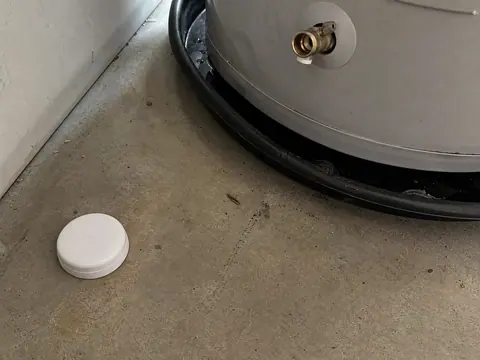 Leak sensor or automatic shutoff valve: which do you need?Start with plug-in sensors at the heater, washer and sinks; add a main-line shutoff if a burst would cost dearly.Depends4,300 gal a day
 Do you need a pressure reducing valve?Put a gauge on a hose bibb with all water off; if it reads well above 60 psi, have a plumber adjust or fit a PRV.Test first45–60 psi
Leaks are 12% of a single-family home's indoor water in EPA's How We Use Water chart, built on the Water Research Foundation's 2016 study, more than the "other" slice that holds baths and dishwashers. EPA's Fix a Leak Week page adds that 9% of homes leak 50 gallons or more a day and that household leaks nationwide waste nearly 1 trillion gallons a year. Repairing the simple ones, it says, cuts about 10% off the bill. Pressure belongs in the same room, because EPA counts irregular pressure among the causes of leaks.
How do you find out whether your house leaks?
Read the water meter, use no water for two hours, and read it again; any change probably means a leak. The meter leak test page walks through it and lists where to look first, starting with toilets.
Is a dripping faucet worth fixing right away?
Yes. EPA counts over 3,000 gallons a year from one drip each second, and the repair starts with closing the stop valve under the sink; dripping faucet covers when to repair and when to replace.
Do you need a leak sensor or an automatic shutoff valve?
It depends on what you want to catch. Floor sensors warn where water pools, while main-line devices watch flow and can close the supply, and leak sensor or shutoff valve explains the trade-offs and the fire-sprinkler caution.
Do you need a pressure reducing valve?
Only if a gauge says so. EPA's target for incoming pressure is 45 to 60 psi, and pressure reducing valve shows the hose-bibb test, which is yours to do, and why fitting or adjusting the valve is a plumber's.
| Decision | Typical gallons a year | Source |
|---|---|---|
| Meter test finds the average home's leaks | 9,300+ | EPA Fix a Leak Week |
| Home in the leakiest 9% | 18,250+ | Our arithmetic from EPA's 50 gallons a day |
| Fix a faucet dripping once a second | 3,000+ | EPA Fix a Leak Week |
| Fix a showerhead dripping 10 times a minute | 500+ | EPA Fix a Leak Week |
| Shutoff device stops a stuck toilet fill valve | up to 4,300 a day | EPA Know Your Flow, Feb 2026 |
| Pressure brought into 45 to 60 psi | no national figure | EPA Home Maintenance |
Source under the table: EPA WaterSense leak and maintenance pages. EPA rows are its published figures; the 18,250 is our arithmetic (50 gallons a day for 365 days); pressure has no national gallon figure, so its row shows EPA's target instead.
Start with the free steps: the meter test, a dye test in each toilet tank, and a gauge on a hose bibb. Devices and valves come after, once you know what you are dealing with. Toilets have their own page, running toilet: fix or replace, and leak repair help from utilities, such as Roseville's in California, is listed under water utility rebates.
How we reached this
This room is ranked in gallons a year where a figure exists. EPA's pages disagree slightly on the household total (9,300 on Fix a Leak Week, 9,400 on Statistics and Facts); we use the first throughout. The fill valve figure is a daily rate from EPA's February 2026 summary and would rarely run a full year unnoticed. We found no confirmed national figure for water saved by lowering pressure, and could not read the plumbing code text on maximum pressure, so neither appears as a number here. Figures were checked 11 Nov 2026.
Sources
- US EPA WaterSense — How We Use Water · leaks 12% of indoor use (WRF 2016) · checked 11 Nov 2026
- US EPA WaterSense — Fix a Leak Week · 9,300+ gallons, 9% of homes, 1 trillion gallons, drip figures, meter test · checked 11 Nov 2026
- US EPA — Know Your Flow guide (February 2026) · device types, irregular pressure as a leak cause · checked 11 Nov 2026
- US EPA — Know Your Flow summary (February 2026) · stuck fill valve 4,300 gallons a day · checked 11 Nov 2026
- US EPA WaterSense — Home Maintenance · 45 to 60 psi target · checked 11 Nov 2026