Hot water piping · a decision
How should a remodel route the hot water?
In a hot water delivery remodel, aim for no more than 0.5 gallons of water in the pipe between the heater and each fixture, EPA's benchmark; open walls are the one cheap chance to get there.
0.5 gal
most water EPA recommends storing in the pipe between the hot water source and any fixture (a benchmark, not a rule)
When walls are open, ask for hot runs holding 0.5 gallons or less; it is the cheapest time to shorten the wait.
Worked out by Where Your Gallons Go from 5 dated sources · numbers checked 11 November 2026
The answer by situation
- Bathroom or kitchen gutted, heater nearbyPlan itShort, right-sized runs can keep each fixture under EPA's 0.5-gallon benchmark.
- New fixture far from the heater, such as an additionLoop or heaterEPA suggests a demand-initiated recirculation loop or a second heater for remote areas.
- Kitchen island on a concrete slabAsk earlyEPA flags islands on slab-on-grade homes as hard to serve efficiently.
- Cosmetic update, walls stay closedSkip itRerouting alone is a big job; insulating reachable pipe is the smaller step.
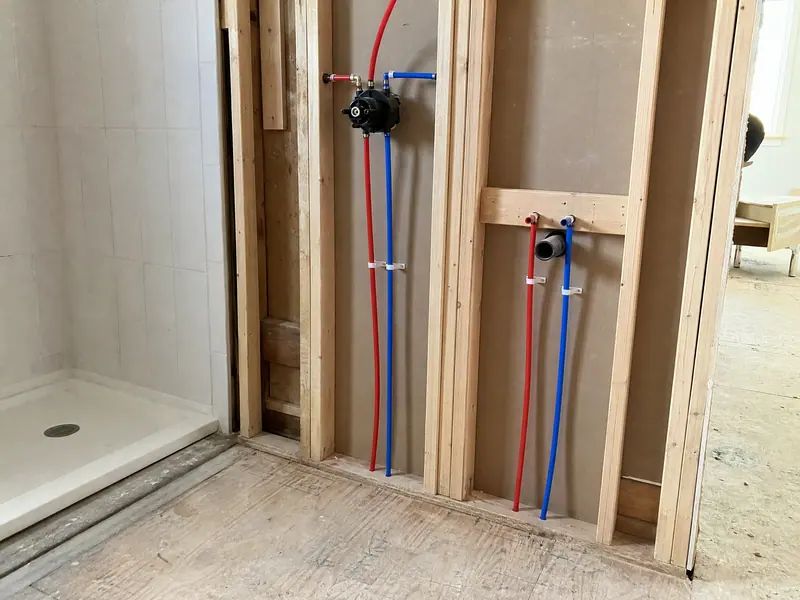
Why does pipe layout decide the wait for hot water?
Every foot of hot pipe holds water that cools between uses and runs down the drain before hot water arrives. EPA's hot water delivery guide (May 2026) puts the average at 6.35 gallons a day per home. Its target is half a gallon or less sitting in the line to each tap, and EPA is clear that this is advice: the WaterSense homes specification now in effect has no such requirement.
Length and diameter both count. In EPA's Table 2, half-inch copper type L holds 1.55 ounces a foot and three-quarter-inch holds 3.22, so the same run in the larger pipe holds about twice the water. EPA's WaterSense homes hot water page offers a volume calculator to add it up for a real plan.
| Pipe | Ounces per foot (EPA) | Feet to reach 0.5 gal | Gallons in 50 ft |
|---|---|---|---|
| ⅜-inch PEX (CTS SDR 9) | 0.64 | about 100 | 0.25 |
| ½-inch PEX (CTS SDR 9) | 1.16 | about 55 | 0.45 |
| ½-inch copper type L | 1.55 | about 41 | 0.61 |
| ¾-inch PEX (CTS SDR 9) | 2.35 | about 27 | 0.92 |
| ¾-inch copper type L | 3.22 | about 20 | 1.26 |
Source under the table: US EPA WaterSense. Feet are our arithmetic: 64 ounces (half a gallon) divided by EPA's Table 2 ounces per foot; real runs also count fittings and any manifold.
Which hot water layout wastes the least?
It depends on the house, but EPA says trunk-and-branch systems "have the greatest potential to be inefficient". That is the common layout: one large main from the heater with smaller branches. EPA's guide describes three alternatives:
- Core: wet rooms grouped around the heater with short, direct runs. Suits smaller homes with few fixtures.
- Whole-house manifold (home run): a small flexible line from a manifold near the heater to each fixture; EPA says ⅜-inch pipe can work in certain cases. Each fixture has to clear its own line.
- Demand-initiated recirculation: a loop kept short and typically within 10 feet of every fixture, so the loop becomes the hot source. See recirculation pumps.
EPA notes that core and manifold systems are hard to retrofit, which is why a remodel is the moment to ask.
Should the water heater move closer to the bathrooms?
Sometimes, and that is a licensed pro's decision. EPA advises locating the heater near hot water use and clustering bathrooms, kitchen and laundry; its Home Maintenance page adds that a demand recirculating system is an option in an existing home. For gas-fired heaters, it tells builders to consult the gas company and every relevant code on location and venting. Moving a gas heater, its vent or its gas line is a licensed plumber's job.
For an addition far from the heater, EPA says a second heater or a demand loop can make more sense than one long pipe. It also says point-of-use heaters are not suitable as backup heaters because they cannot serve a whole house.
Should pipes be smaller as well as shorter?
Often, within code. EPA says older sizing methods can predict peak demand 5 to 27 times higher than observed flows, which leads to oversized pipe. Where local code allows, plumbers can use IAPMO's Water Demand Calculator for a closer estimate. EPA cautions that pipe must not be shrunk so far that fixtures stop working, so sizing stays with your plumber and your code office.
What should go on the plan besides pipe?
Insulation on every reachable hot line, sized so its wall matches or beats the pipe's diameter, which EPA says halves the cooling between heater and tap; the Energy Department's archived pipe-insulation page adds the gas-flue clearances. See insulating hot water pipes. Then fit WaterSense showerheads and faucets so the hot water that does arrive goes further. Compare the options on the hot water page.
When the answer flips
- Walls stay closed: rerouting is rarely worth it alone; insulate what you can reach.
- The heater is gas and must move: the plan still works, but the move is a licensed pro's job with a permit.
- The far fixture is in an addition: a demand loop or a second heater may beat one long run.
- Local code sets pipe sizes your plumber must follow: the 0.5-gallon target bends to code, not the reverse.
What to buy or ask a plumber
- Ask the plumber how many gallons each hot run will hold; EPA's benchmark is 0.5 or less.
- Ask whether a core, manifold or demand-loop layout fits your floor plan better than trunk-and-branch.
- Ask whether your code office allows sizing with IAPMO's Water Demand Calculator.
- Ask for insulation on every hot line left exposed before the walls close.
- Leave any gas heater move, venting or gas line to a licensed plumber.
Also asked
Is PEX better than copper for hot water waste?
For the same nominal size, PEX of this type holds a little less water per foot in EPA's table: 1.16 ounces for half-inch PEX against 1.55 for half-inch copper type L. Layout and length matter more than material.
What is EPA's Hot Water Distribution Volume Calculator?
A spreadsheet EPA offers on its WaterSense homes page that adds up the water stored in a planned layout from pipe lengths, sizes and materials. Builders and plumbers use it to test a design against the 0.5-gallon benchmark.
Is the 0.5-gallon rule required by code?
Not by the WaterSense homes specification now in effect; EPA calls it a recommended benchmark. Local codes have their own rules, which your plumber or code office will know.
Does a manifold system waste more water at each tap?
It can at fixtures used one at a time, because each fixture has its own line and cannot ride on another tap's warm water. Small pipe keeps each line's volume low.
How we reached this
Everything here comes from EPA's WaterSense hot water guide of May 2026, written for builders, and its homes web page, both checked 11 Nov 2026. The feet-to-half-a-gallon column is our arithmetic from EPA's Table 2, which EPA adapted from the 2024 International Plumbing Code. We did not read local plumbing codes, which set pipe sizes and permits, so those decisions stay with your plumber. No cost figures are given for rerouting or a second heater.
Sources
- US EPA WaterSense — Best Practices for Efficient Hot Water Delivery in Homes (May 2026) · layouts, Table 2 volumes, sizing, heater placement, gas venting note · checked 11 Nov 2026
- US EPA WaterSense — WaterSense Labeled Homes: Hot Water · 0.5-gallon benchmark, volume calculator · checked 11 Nov 2026
- US EPA WaterSense — Specification for Homes v2.0 (Feb 2021) · no hot water delivery requirement · checked 11 Nov 2026
- US EPA WaterSense — Home Maintenance · demand recirculation as a retrofit option · checked 11 Nov 2026
- US DOE Energy Saver — Insulate Hot Water Pipes · gas-flue clearances for insulation · archived copy of 1 Jan 2026
More from the hot water
 Is a hot water recirculation pump worth it?Worth it for long waits if it is a demand-start pump; skip timer or always-on pumps, which can raise energy use.Demand only6.35 gal a day
 Should you insulate your hot water pipes?Insulate exposed hot pipes, first 3 feet at the heater first; keep foam at least 6 inches from a gas flue.Insulate50%